
'Nematode research is more important than fire insurance for our house'
— Pieter, Marcel Lucassen
Growth through choices and challenges
Pieter is the third generation in the North Limburg family business MTS Lucassen. His grandparents start a mixed farm in 1920. His parents expand with pigs, arable farming and outdoor vegetable cultivation. In the early 1990s, Pieter steps into the business. "Further expansion of the pig business was not possible because of nearby nature reserves, and I could not earn a dry living with vegetable cultivation," he says of his decision to start growing dahlias, and later astilbes, in 1987. It turned out to be a golden decision. The company is growing fast. Very fast.
When at some point his father falls ill and Pieter himself is out of the running for a while due to an industrial accident, he is forced to think about the future. "I had never looked into things like fertilizer. Dad did such things with his fingerpitzengefuhl. I don't have that. Besides, due to legal fertilizer standards, I had to come up with something else to keep growing."

Less fertilizer, better soil life
Pieter comes across the Kinsey-Albrecht analysis. A measurement method to map the mineral balance in the soil. A world opens up for him. "When we had the first soil samples taken, it turned out we needed to fertilize much less than we used to. Soon the quality of our soil improved very much with much less fertilizer. I discovered more and more that we have to cultivate completely differently. We are in fact killing our earth with all these chemicals in the soil. Where many still spray to combat a spot on a plant, we now look into the soil." And with success. Diseases and infestations have all but disappeared because of the ban on artificial fertilizer at MTS Lucassen.

'Never skimp on your nematode research!'
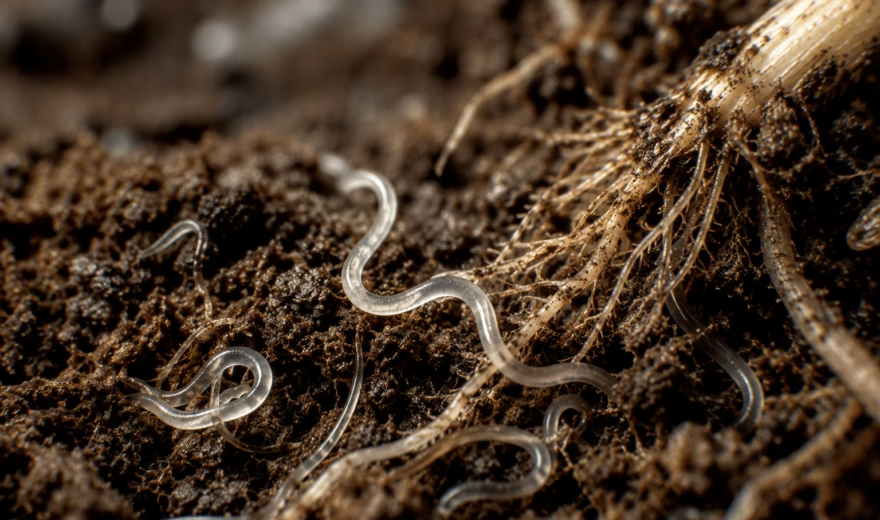
The Limburg plant grower calls himself "a connoisseur of soil life. "Nematodes are also part of the soil. Every grower has nematodes in the soil. Not every nematode is bad for plants, but the species that are, cause major crop damage." He considers it "vitally important" to know each year what the nematode levels are in his soil. "We believe you should never skimp on your soil testing. Some growers think the cost is too high. I don't understand how they can reason like that. It only has to go wrong once with a corn root knot nematode or root lesion nematode in the soil and you have already recouped your entire nematode testing investment! It is a risk coverage for your business. Nematode testing is even more important to me than all-risk insurance for my car or fire insurance for my home!"

From DNA to microscopic examination
MTS Lucassen has the soil samples for their nematode research pricked by Smeets Agro. This brings the samples to Normec Robalab in Deurne. Whereas the plant growers previously had the nematodes in their soil determined via DNA technology, they now opt for microscopic determination. "Quality is the key word for us. Everything is counted several times at Normec Robalab. That is necessary to rule out every harmful nematode. You can't take any chances. We have much more confidence in this technique than in a DNA technique that also cannot yet detect all nematodes. We also have more stable figures now. With DNA research there were always unexplained outliers. But we have to be able to trust our figures. That's why we stopped those DNA tests."
Soil improvement and plant resilience
Since 2022, MTS Lucassen has been an official demonstration company of the Ministry of LNV. To this end, Pieter and Marcel receive fellow entrepreneurs, researchers, students and other interested parties at their farm. "We tell about our approach to soil improvement and work specifically on plant resilience. We also work together with the HAS Venlo and introduce students to sustainable soil improvement. We hope to inspire growers of the future with our good results."
How do you keep soil healthy?
The question every grower should start asking himself, according to Pieter, is: how can I keep my soil healthy and increase the resilience of my plants? He smiles broadly as he gives the answer himself. "Soil is a living organism. Plants need an interplay of natural factors. Plants improve the soil themselves in the symbiosis between healthy bacteria, fungi and plants. Did you know that how we treat our soil has a direct effect on CO2 emissions and the nutritional values of our food?"
The future
In his advocacy of annual soil testing and plant resilience, he emphatically looks beyond his own field. "Healthier crops also mean healthier food. I am convinced that if vegetable growers have the soil of their crops analyzed annually and fed exclusively with organic manure, they can improve not only the life of their plants, but also public health." A sustainable goal to which the enthusiastic grower would like to commit himself in the future. With meanwhile the fourth generation of Lucassen at his side.
Need help?
Our specialists will be happy to support you with nematode research. They help you protect your crops. Read more on our page about nematode research or contact us.

Want to know what's going on in the food sector?
Subscribe to our free newsletter


