Accessibility links Skip to main content

Labeling & legislation: 3 pitfalls for food manufacturers

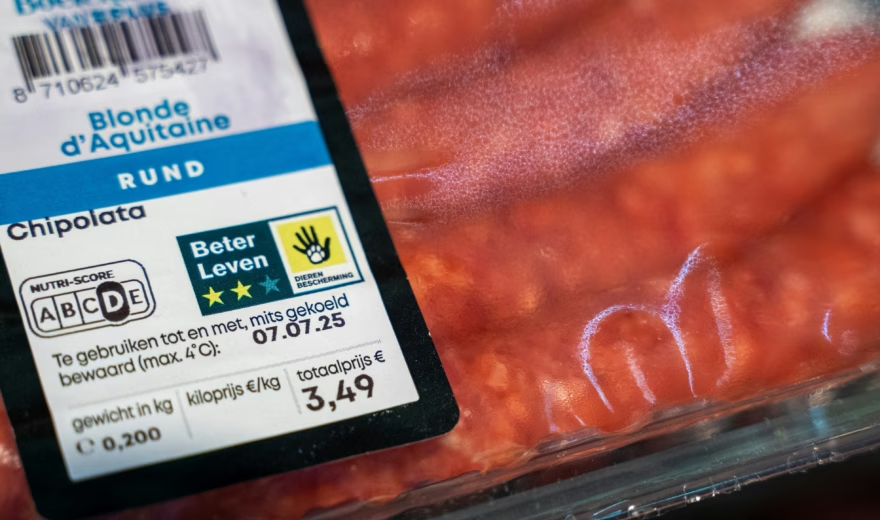
Creating a good label for a food product is often trickier than it seems. Because of all the rules and exceptions, it quickly feels like you have to find your way through a maze of legislation. The basis lies in Regulation (EU) No. 1169/2011 - which tells you all the things you have to mention on your packaging if you sell your product in Europe. But it doesn't stop there. Depending on the product you are marketing, all kinds of additional rules may apply. At Normec Foodcare we have a separate department with Labeling Specialists who work daily on, among other things, label checks and solving labeling and legislative issues. In practice, we see that things regularly go wrong and that labels - usually unconsciously - do not comply with legislation. Labeling is precision work and a mistake is easily made. In this article we take you through the biggest pitfalls in food labeling so that you as a producer, marketer or quality manager can avoid these mistakes.

Continue reading

1. Knowledge of the correct legislation

A common pitfall in food labeling is insufficient knowledge of exactly which legislation applies to your product. While Regulation (EU) No. 1169/2011 forms the basis for labeling in Europe, additional rules may apply depending on what you make or sell - and these may differ from product to product and country to country. There are two types of legislation you need to consider. First, there is horizontal legislation: these are rules that apply to all foods, such as those on additives, flavourings, nutrition and health claims. Think, for example, about which E numbers are allowed in a particular product group and when you can call a flavoring "natural. There is also vertical legislation, which focuses precisely on specific product groups such as chocolate, meat or food supplements. For example, the labeling requirements for food supplements are not the same as for other foods. In addition to European legislation, there are also national regulations, which differ from country to country. What is allowed in the Netherlands may be slightly different in Belgium or Germany - for example, in terms of language or permitted ingredients or wording. In the Netherlands, for example, it is legal when you can and must call bread 'whole wheat'. This legislation does not apply to other countries in Europe. So don't forget to always check whether country-specific rules apply to your product, especially if you export.

2. Translations

Mandatory indications and claims on the label must be in the language understandable to consumers of the member state where the product is sold. Member states may impose requirements on the language used on labeling in their territory. Therefore, if you market products in different countries, you must also translate the labels. A pitfall here is translating labels without paying attention to legislation and nuances of language and culture. It may seem easy to translate a label from Dutch into English, German or French, but a direct translation is often not enough. A number of legal texts are laid down literally in the various language versions of Regulation (EU) No. 1169/2011, but also in other regulations. Consider, for example, nutritional values and additive designations. An online translation engine would translate the category name "acid" into Dutch as "acid," while the correct legal name is "food acid.

Language differences can also lead to consumer confusion or even deception. Consider, for example, names that may have different meanings in different languages. Or designations that are understandable in one country but unclear or incorrect in another. For example, if a common name such as "bitterball" or "gingerbread" is translated literally, the name will not be clear in other countries. Do you import or export outside of Europe? Then be aware that different labeling rules apply outside Europe and that just translating the label is not enough. First, the label will have to be prepared according to applicable laws. In the US, for example, the nutrition table is set up differently and the amount of carbohydrates is calculated differently. Therefore, the nutrition table cannot be reproduced verbatim for products marketed in Europe.

3. Misleading the consumer

Another pitfall in food labeling is misleading the consumer. According to Regulation (EU) No. 1169/2011, food information must not be misleading, ambiguous or confusing. In addition to these legal provisions, deception can also cause loss of consumer confidence. It is therefore essential that labels are always transparent and accurate so that consumers do not have false expectations and can make an informed choice.

Misleading consumers can occur through the use of unclear or misleading claims, images or terms on the label. For example, a product may be called "natural" when it actually contains artificial ingredients. Or a picture may be shown of an ingredient when the product does not contain that ingredient or contains very little.

Specific legislation has been established for nutrition or health claims on food products. These claims must comply with Regulation (EU) No. 1924/2006, the so-called Claims Regulation. This lays down what you have to comply with to be allowed to state a claim such as 'sugar-free', 'high in fiber' or 'vitamin C supports the immune system'.

If you want to make a claim, first check whether your product meets the general conditions for making a claim. Then check whether legislation has been established for the claim in question and whether your claim complies with it. Make sure you can properly substantiate the claim and that the correct wording has been used.

Ask your labeling question

In this article, we have mentioned some common pitfalls in food labeling. As a business, it is essential to stay abreast of the rules and regulations that apply to the labeling of your products so that you comply with the law and avoid misleading consumers. Do you have a labeling question of your own or run into a specific problem? Our team of Labeling Specialists is ready to help you with expert advice, so you can ensure proper, honest information on your products.

Need support in the food sector?

Our experts are happy to think with you and help you quickly on your way.