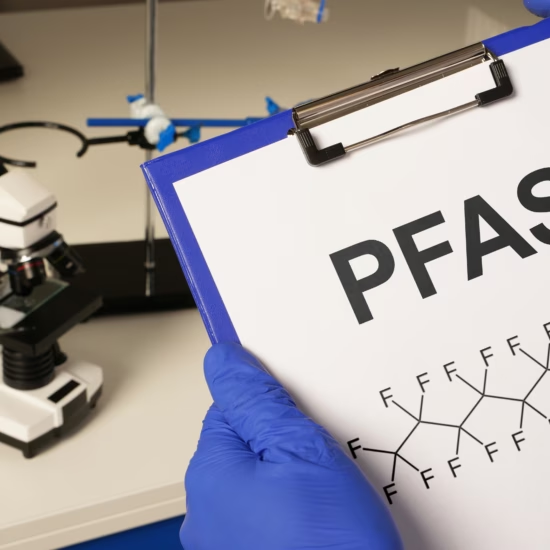
What are PFAS and why are they relevant to water quality?
PFAS are a large family of man-made chemicals widely used since the 1940s for their water, grease and dirt-repellent properties. They are used in products ranging from coatings for textiles and cookware to fire-fighting foams and industrial processes. The distinguishing feature of PFAS is their extreme stability: chemically, they are designed not to degrade in the environment.
Toxicologically, PFAS are problematic because some compounds are well absorbed by the human body and circulate there for long periods of time. Long-term exposure to certain PFAS compounds has been associated in epidemiological and toxicological studies with increased risks of cancer, immune system disruption, hormonal effects, and developmental and reproductive toxicity. These effects often occur only at low, chronic exposures, so even trace amounts in drinking water may be relevant to long-term public health.
EU Drinking Water Directive: Harmonization of PFAS Monitoring and Standards
The revision of the European Drinking Water Directive, adopted in 2020, introduces for the first time specific obligations to measure and regulate PFAS in drinking water. This directive came into force in January 2021 and had to be transposed into national legislation by Jan. 12, 2023. As of Jan . 12, 2026, the new limit values and monitoring obligations are binding on all member states.
The EU directive offers two alternative parameters for standard setting:
- PFAS Total: the sum of all PFAS compounds with a limit value of 0.5 µg/L (500 ng/L).
- Sum of PFAS-20: the sum of 20 selected PFAS compounds of concern, with a limit value of 0.1 µg/L (100 ng/L).
Member states may choose one or both parameters upon implementation.
National implementation of the Directive in the various member states
To effectively implement the EU Drinking Water Directive, member states must transpose the European standards into national laws and regulations. In practice, this means that each country draws up specific standards, implementation dates and control schemes to translate the European requirements into national regulations.
Below is an overview of how Belgium and the Netherlands have implemented this directive:
Belgium
Belgium adopted the EU limits with the introduction of 0.1 µg/L for Sum of PFAS-20 and 0.5 µg/L for PFAS Total as of Jan. 12 , 2026 in the RD on the quality of water intended for human consumption. For bottled waters, the 0.1 µg/L limit was already in effect from Feb. 4, 2024. For natural mineral waters, PFAS must be practically absent: below the analytical quantification limit (± 0.020-0.040 µg/L). The Supreme Health Council has also published recommendations on PFAS and perchlorates in bottled and process waters in addition to legislation.
Royal Decree of February 4, 2024 on the quality of water intended for human consumption (EN)
Royal Decree of February 8, 1999 on natural mineral water and spring water
The Netherlands
In the Netherlands, the Drinking Water Act forms the basis. This law states, for example, how the public drinking water supply should be organized. The Drinking Water Decree and the Drinking Water Regulation state the requirements that drinking water in the Netherlands must meet. These requirements are based on the European Drinking Water Directive. Dutch legislation applies the EU limits of 0.1 µg/L for Sum of PFAS-20 and 0.5 µg/L for PFAS Total as of Jan. 12 , 2026. RIVM additionally recommends, based on health data, lower target values for the specific substances PFAS-4 (PFOA, PFNA, PFHxS, PFOS).
PFAS in focus: why 'sum PFAS' and 'PFAS total' are crucial
Legislation surrounding drinking water and process water often mentions two types of PFAS parameters: sum of selected PFAS compounds and PFAS total. The distinction is important for both monitoring and risk assessment. The sum of specific PFAS, such as PFOA, PFOS, PFNA and PFHxS, is used because these compounds are well studied, are known to be PBT compounds (Persistent, Bioaccumulative and Toxic ) and thus exhibit relatively high toxicity and bioaccumulation. PFAS total, on the other hand, includes all per- and polyfluoroalkyl substances, including unknown or less studied compounds, and provides a picture of the total load on water resources. By monitoring both parameters, legislation can both target the most toxic and regulated PFAS and provide broader protection from all persistent contaminants that may be present in drinking and process water.
PFAS and their risk characteristics.
Persistent pollutants.
PFAS are characterized by their exceptional chemical stability. They hardly break down in the environment and therefore remain present in soil, water and sediment for years or even decades. This persistence underlies their widespread presence in drinking water sources. Examples: PFBA, PFPeA, PFHxA, PFBS.
PBT substances (Persistent, Bioaccumulative and Toxic).
A number of classic, mostly long-chain PFAS meet all PBT criteria. These substances accumulate in the human body and in animals, with demonstrable toxic effects on liver function, the immune system and reproduction, among others. For these PFAS, not only long-term exposure through water is problematic, but also cumulation through food and environment. Examples: PFOA, PFNA, PFDA, PFOS, PFHxS.
PMT substances (Persistent, Mobile and Toxic).
Other PFAS are less bioaccumulative but highly mobile in water. Due to their high solubility, they migrate easily through soil and groundwater and are difficult to remove by conventional water treatment techniques. These very properties make PMT-PFAS particularly critical for drinking water abstraction and process water use, even at very low concentrations. Examples: PFBA, PFPeA, PFBS, PFHxA.
The PBT and PMT classification explains why PFAS pose both a health risk and an operational risk. Whereas PBT substances are primarily relevant from toxicological and food safety perspectives, PMT substances pose structural challenges to water quality, compliance and risk management in production processes.
From cause to analysis: PFAS management in drinking and process water
-
1.
Causes of PFAS Contamination.
PFAS contamination of water can have several sources: industrial discharges, diffuse emissions from consumer products, atmospheric deposition, and leaching of chemicals from soil and waste. Historical uses, such as the use of PFAS-containing firefighting foam around airports and military sites, have now been shown to be significant sources of local ground and surface water contamination.
-
2.
Prevention and Treatment Options.
Because of the extreme persistence of PFAS, prevention is the first line of defense. This means minimizing PFAS use, improved process and waste management practices, and implementing polluter-pays principles to hold polluters accountable for emissions and remediation.
Within water treatment chains, some technologies can achieve reductions in PFAS concentrations in process and drinking water such as advanced filtration (reverse osmosis, nanofiltration), adsorption technologies (e.g., activated carbon) or advanced oxidative treatments. These are costly processes where treatment residues require additional care. As a result, prevention and source management remain a critical part of risk management.
-
3.
Importance of analysis and monitoring
For QA managers in the food industry, analysis and monitoring of water quality is primarily a preventive tool, not a mere legal requirement. Drinking and process water are critical commodities: exceeding PFAS limits can lead to production stoppages, lockouts or recalls, increased audit pressure and reputational damage. Moreover, prolonged exposure to elevated PFAS concentrations can give rise to accumulation in products, further increasing food safety risk.
Structural, reliable monitoring makes it possible to detect trends and deviations early, even before legal limits are effectively exceeded. Thus, targeted measures can be taken at the source, in the process or in water treatment, and reactive intervention is avoided. Sufficient and qualitative analyses are thus a key to both operational continuity and proactive food safety.

PFAS analyses with certainty by Normec
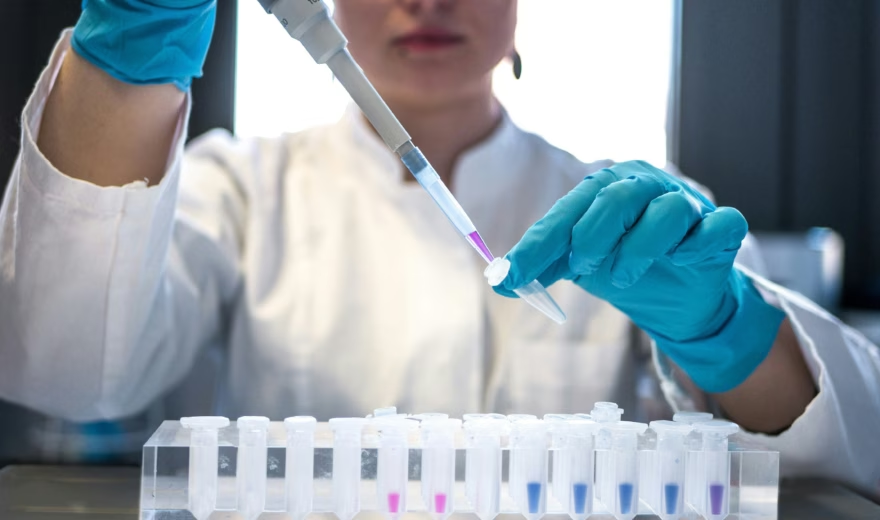
Working with Normec means choosing certainty, expertise and future-oriented PFAS monitoring. Our laboratories in the Netherlands and Belgium perform comprehensive PFAS analyses for both groundwater and drinking water, including classical and ultra-short-chain PFAS. Thanks to our in-depth experience and high-quality analytical methods, our results are audit-proof, legally sound and suitable for compliance, licensing and enforcement.
Since January 6, 2026, Normec is also VLAREL-approved in Belgium for PFAS analyses in groundwater and drinking water. This recognition is essential, as only VLAREL-recognized analyses are legally acceptable within the Flemish regulatory framework. With our recognition for packages W.7.9.1 and - as the only laboratory - W.7.9.2, we offer a complete and officially recognized analytical framework in Flanders, also for the most challenging PFAS compounds.
For QA managers in the food industry, this goes beyond mere compliance with legislation. It means proactively managing risks, making informed decisions and building trust with regulators, auditors and customers. This makes Normec more than a laboratory; it is a strategic partner in water quality and food safety.
For more info or request analyses à contact us!
Belgium: Sales@normecfoodcontrol.com tel: 09 363 80 14
Netherlands: zaki.al.salihi@normecgroup.com tel : +31 6 82 32 24 19
Need support in the food sector?
Our experts think along with you and help you quickly on your way.