23 Jun 2026
Sustainable Packaging: The Underestimated Risks to Shelf Life and Food Safety
Sustainable packaging: the underestimated risks to shelf life and food safety
Sustainability has long since ceased to be an afterthought. Whereas the first wave of sustainability initiatives in the food industry focused mainly on visible measures such as less plastic, modified packaging and energy savings, it is now clear that the next step goes much further. Sustainability 2.0 is about a broader, integrated approach in which environment, quality, safety and people reinforce each other. For QA managers, this means a shift from a supporting to a strategic role. Their expertise in process control, traceability and risk management makes them ideally suited to link sustainability to the core of business operations. After all, sustainability is not only about what an organization does to reduce its impact on the environment, but also about how it makes itself future-proof.


A sustainable company is not just focused on saving energy or reducing waste, but strives for stable processes that prevent waste, ensure food safety and take social responsibility seriously. A good example is how quality assurance can help reduce food waste. By better monitoring processes and analyzing causes of rejection, not only the ecological footprint decreases, but also the financial loss.
Waste streams can also be rethought from a quality perspective: what is considered a residue today can be a raw material tomorrow - provided safety and traceability remain guaranteed. Social sustainability is also playing an increasing role. Fair working conditions, attention to welfare and cooperation with local partners not only contribute to a positive social image, but also to loyalty and continuity within the company itself. Sustainability 2.0 is thus no longer a collection of separate initiatives, but a framework for thinking in which everything is connected.
A tool that helps companies strategically embed sustainability is the dual materiality analysis. Whereas a classic materiality analysis looks primarily at what is important to the company itself, the dual variant also examines what impact the company has on its environment. This two-way perspective helps focus on where the greatest risks and opportunities lie.
For QA managers, it provides a clear starting point for setting priorities and developing targeted actions. For example, if it turns out that food waste is a material issue both ecologically and economically, the action plan can focus on process optimization and extending shelf life, with positive effects for the environment, reputation and profitability.
Companies that structurally integrate sustainability into their quality and safety policies find that the benefits extend beyond compliance alone. More efficient processes, fewer rejects, lower operational costs and a stronger reputation with customers and employees are direct results of a well-embedded sustainability strategy. Moreover, an integrated approach helps meet new European reporting requirements, such as the CSRD, where companies are increasingly being held accountable for their social and environmental impact.
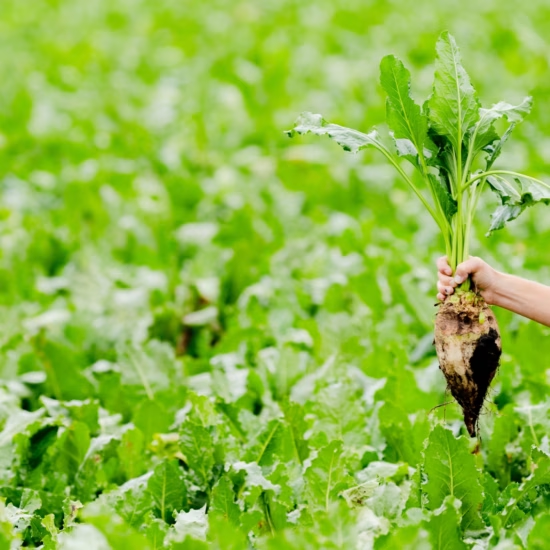
The future of sustainability in the food industry lies not in individual projects or campaigns, but in the connection between themes. When food safety, waste, waste management and social responsibility are no longer seen as separate components, a robust system emerges that creates value for all stakeholders.
For QA managers, there is a unique opportunity there: by approaching sustainability as an extension of quality assurance, they become not only custodians of standards, but also architects of a sustainable, forward-looking food chain.
Our experts are happy to think with you and help you quickly on your way.
Sustainable packaging: the underestimated risks to shelf life and food safety

As a production company, you regularly perform lab and microbiological analyses: sampling of the environment, of raw materials, semi-finished and finished products. How do you perform this correctly and what are important things to consider?

PFAS have been high on the European agenda for several years now. While attention used to be focused primarily on drinking water, soil contamination, and industrial emissions, the focus is increasingly shifting to packaging materials that come into contact with food.
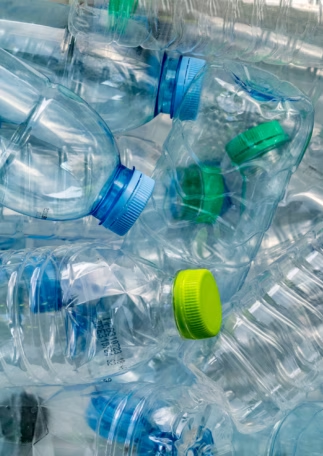
The Packaging and Packaging Waste Regulation (PPWR) marks a significant change in European packaging legislation. The new rules affect not only packaging manufacturers but also the entire supply chain, including food companies and QA teams. What exactly does the PPWR entail? What specific changes will there be for food contact materials? And how can your organization prepare for this? We asked an expert in food contact materials and packaging compliance.