Accessibility links Skip to main content

International baby food incident. What does this say about our QA systems?

Recent issues surrounding baby food, including large-scale and pre-emptive recalls, have led to consumer unrest and pressure on availability in the supply chain. This situation poses a fundamental question for the food industry: how robust are our food safety and QA systems when things get really tense? Baby food is a product category with the highest safety expectations. For this very reason, any disruption in this market acts as a magnifying glass for structural vulnerabilities that are also present in other segments of the food industry.

Continue reading

What specifically happened? 1

In December 2025, a supplier of a raw material for infant formula discovered that an ingredient may have been contaminated with cereulide, a toxin produced by the bacterium Bacillus cereus. This ingredient - an arachidonic acid (ARA) oil - was used in the production of infant formula and was unexpectedly found to contain cereulide. Nestlé subsequently informed the Dutch Food and Consumer Product Safety Authority (NVWA) in late December about the possible contamination in the raw material, but the product line in question was not intended for the Dutch market.

In early January 2026, Nestlé launched a preventive recall of certain infant formulae (such as SMA, BEBA and NAN) in Germany after analyses revealed the contaminated raw material. This action was intended as a precautionary measure, and not because a direct link to disease cases had been demonstrated. Subsequently, other major producers - including Danone and Lactalis - also withdrew several batches of their infant formula in several countries after the same raw material (or related risks) were identified.

While most of the recalls did not report serious illnesses, there have been reports of mild gastrointestinal complaints in infants associated with products from the recalled batches, and investigations are ongoing into some deaths of infants who had consumed products from recalled batches (with no direct causal link yet confirmed).

As a result, numerous formulas have been withdrawn from the market worldwide, across Europe and other continents, to minimize risks to vulnerable infants.

The incident highlights the importance of strict quality control, thorough testing of supplier ingredients and robust monitoring of microbiological risks in the infant formula supply chain.

1 This review was prepared based on information available at the time of writing. Given ongoing developments, new insights or updates may now be available.

INFO:

Cereulide is a toxin produced by certain strains of the bacterium Bacillus cereus. This bacterium is widespread in the environment, including in soil and dust, and can contaminate foods such as rice, pasta and dairy products.

Cereulide is particularly heat-resistant. This means that the toxin is usually not inactivated or destroyed by cooking, using boiling water or during the preparation of baby food. Even properly prepared infant formula can still contain the toxin and cause illness.

Infants may experience symptoms such as vomiting, diarrhea, abdominal pain and cramps within hours of drinking contaminated food. Infants may additionally become lethargic and show signs of dehydration.

Although most cases resolve spontaneously within 6 to 24 hours without treatment, severe cases, characterized by persistent, frequent or severe symptoms, can be life-threatening if not treated promptly, similar to other forms of food poisoning in infants.

An incident of broader significance

The recent baby food issues, including large-scale and preventive recalls, have led to consumer unrest and pressure on availability in the supply chain. This situation poses a fundamental question for the food industry: how robust are our food safety and QA systems when things get really tense?

Baby food is a product category with the highest safety expectations. For this very reason, any disruption in this market acts as a magnifying glass for structural vulnerabilities that are also present in other segments of the food industry.

The chain as a critical success factor

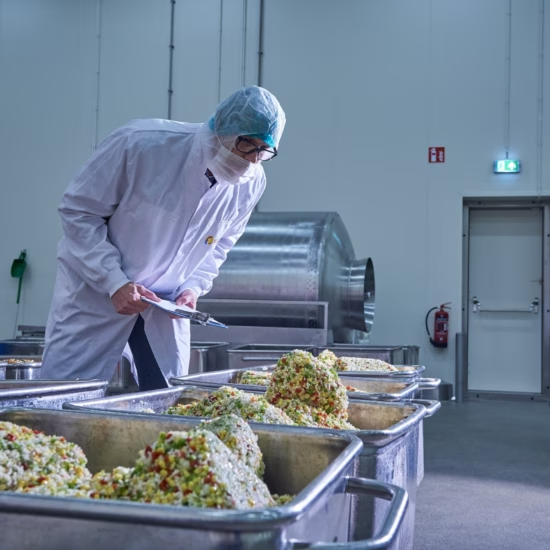
What is striking in this case study is that the potential risk did not originate in the final product itself, but in an ingredient sourced from a supplier. This again emphasizes how decisive chain control is for the effectiveness of the QA system. Specifications, audits and contractual agreements provide a necessary basis, but in practice do not always prove sufficient to eliminate low-frequency, high-impact risks.

For QA managers, this is a clear reminder that supplier management should not be a static process. Especially with sensitive product groups, this requires constant alertness to changes in processes, raw materials and supplier conditions.

When detection is not the same as prevention

On the positive side, the risk was detected in time and organizations intervened before consumers were actually harmed. At the same time, the situation shows that detection often occurs only after products have already been produced and distributed. This raises the question of the extent to which management measures are sufficiently preventive.

In daily practice, the focus is still often on final checks and verification, while precisely preventive measures earlier in the process yield the greatest risk reduction. For QA professionals, this is an invitation to critically reassess risk analyses and also explicitly include rare scenarios.

QA doesn't stop at compliance

The impact of the recalls went beyond the affected batches alone. Parents faced empty shelves and were forced to switch to alternative products, sometimes with uncertainty about suitability or tolerance. This highlights that QA decisions not only have technical or legal implications, but also direct social impact. Crisis management, internal coordination and clear communication prove at least as important in such situations as the formal quality system. In this, QA plays a connecting role between food safety, continuity and trust.

Lessons for daily practice

These developments make it clear that even mature organizations with extensive systems remain vulnerable. For QA managers, this is no reason for restraint, but rather an opportunity to further strengthen systems. By looking more sharply at chain risks, preventive control and the impact of decisions outside the factory gate, QA is increasingly becoming a strategic discipline.

Why testing for cereulide is essential

The recent baby food incident highlights how critical it is to preventively test high-risk products. Cereulide, a heat-stable toxin from Bacillus cereus, is found primarily in starchy products such as rice, pasta as well as in foods for infants and young children, where even very low concentrations pose a serious risk.

Which products are at risk?

Besides rice and pasta products, infant formula, dietary foods and raw materials are also susceptible to contamination. Incidents show that cereulide levels as low as µg/kg can lead to intoxication.

Normec now offers cereulide analysis

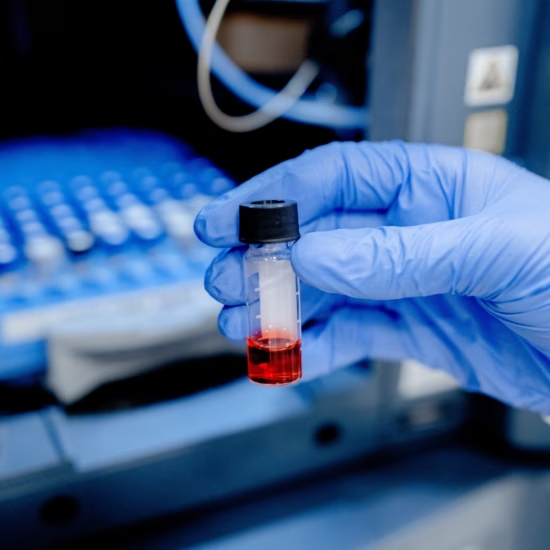
In response to recent developments, Normec Labor Friedle quickly developed and validated a reliable analytical method. Cereulide tests are now available in-house, with a low detection limit and fast turnaround time. This gives you quick assurance of the safety of your products.

Need support in the food sector?

Our experts are happy to think with you and help you quickly on your way.