
From a Niche Substance to a Current Risk
PFAS have been a major focus of attention in the food industry for several years. Recently, however, a specific substance has been cropping up more and more frequently in discussions about food safety, the environment, and regulations: TFA, or trifluoroacetic acid.
An increasing number of research institutions, regulatory agencies, and media outlets are reporting on the presence of TFA in surface water, groundwater, and food products. As a result, food companies are also receiving more and more questions about potential risks, analyses, and future regulations.
What exactly is TFA? Why is this substance currently receiving so much attention? And what does this mean for QA and compliance professionals?
What is TFA, and what makes it different?
TFA stands for trifluoroacetic acid and belongs to the group of per- and polyfluorinated compounds. The substance is considered an ultrashort-chain PFAS and differs from better-known PFAS such as PFOS and PFOA due to its very small molecular structure.
It is precisely this property that makes TFA unique. The substance is extremely mobile in the environment, dissolves easily in water, and is hardly degraded. Once present in the environment, TFA can therefore spread over long distances and persist for a long time.
Although TFA generally bioaccumulates less than some long-chain PFAS, concerns are growing about the continued increase in concentrations in water and potential exposure through food.
Why is this topic coming up now?
Attention to TFA is growing rapidly because researchers are finding the substance in the environment with increasing frequency. Moreover, improved analytical techniques now allow for the detection of much lower concentrations than just a few years ago.
In addition, it is becoming increasingly clear that TFA is not only used directly but also forms as a degradation product of various fluorinated substances. These include certain PFAS compounds, crop protection products, industrial chemicals, and some refrigerants.
As a result, TFA can continue to form even long after the original substance is no longer present.
This poses a challenge for policymakers. While much of the current regulatory focus is on traditional PFAS, there is a growing awareness that degradation products such as TFA also play a significant role in the overall PFAS issue.
Why is TFA relevant to the food industry?
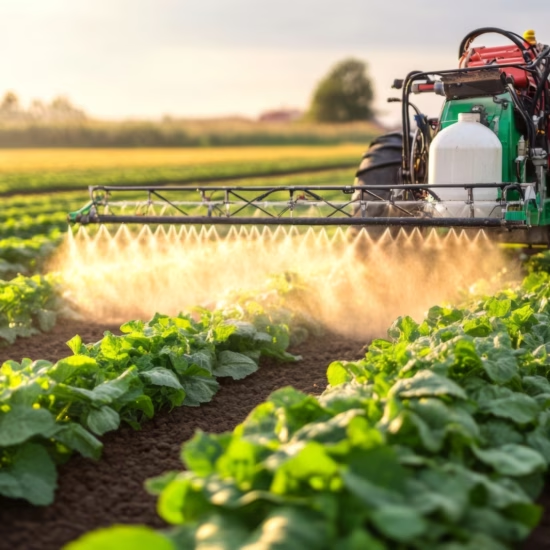
TFA is particularly relevant because this substance can enter the food chain via water. After all, water plays a central role in the food industry: it is used as an ingredient, as process water, for cleaning, for crop irrigation, and as drinking water for animals. When TFA is present in water sources, it can therefore eventually end up in agricultural products and foodstuffs.
This makes it particularly important for sectors that are heavily dependent on water to take this into account, such as fruit and vegetable cultivation, potato processing, the beverage industry, dairy production, the plant-based food sector, and baby food manufacturers. This also includes companies that use their own groundwater extraction systems.
In addition, there is growing concern about the potential presence of TFA in raw materials sourced from regions where elevated concentrations have been detected in surface water or groundwater.
Why is TFA relevant to the food industry?
TFA is particularly relevant because this substance can enter the food chain via water. After all, water plays a central role in the food industry: it is used as an ingredient, as process water, for cleaning, for crop irrigation, and as drinking water for animals. When TFA is present in water sources, this can ultimately lead to its presence in agricultural products and foodstuffs.
This makes it particularly important for sectors that are heavily dependent on water to take this into account, such as fruit and vegetable cultivation, potato processing, the beverage industry, dairy production, the plant-based food sector, and baby food manufacturers. This also includes companies that use their own groundwater extraction systems.
In addition, there is growing concern about the potential presence of TFA in raw materials sourced from regions where elevated concentrations have been detected in surface water or groundwater.
Why is analyzing TFA technically challenging?
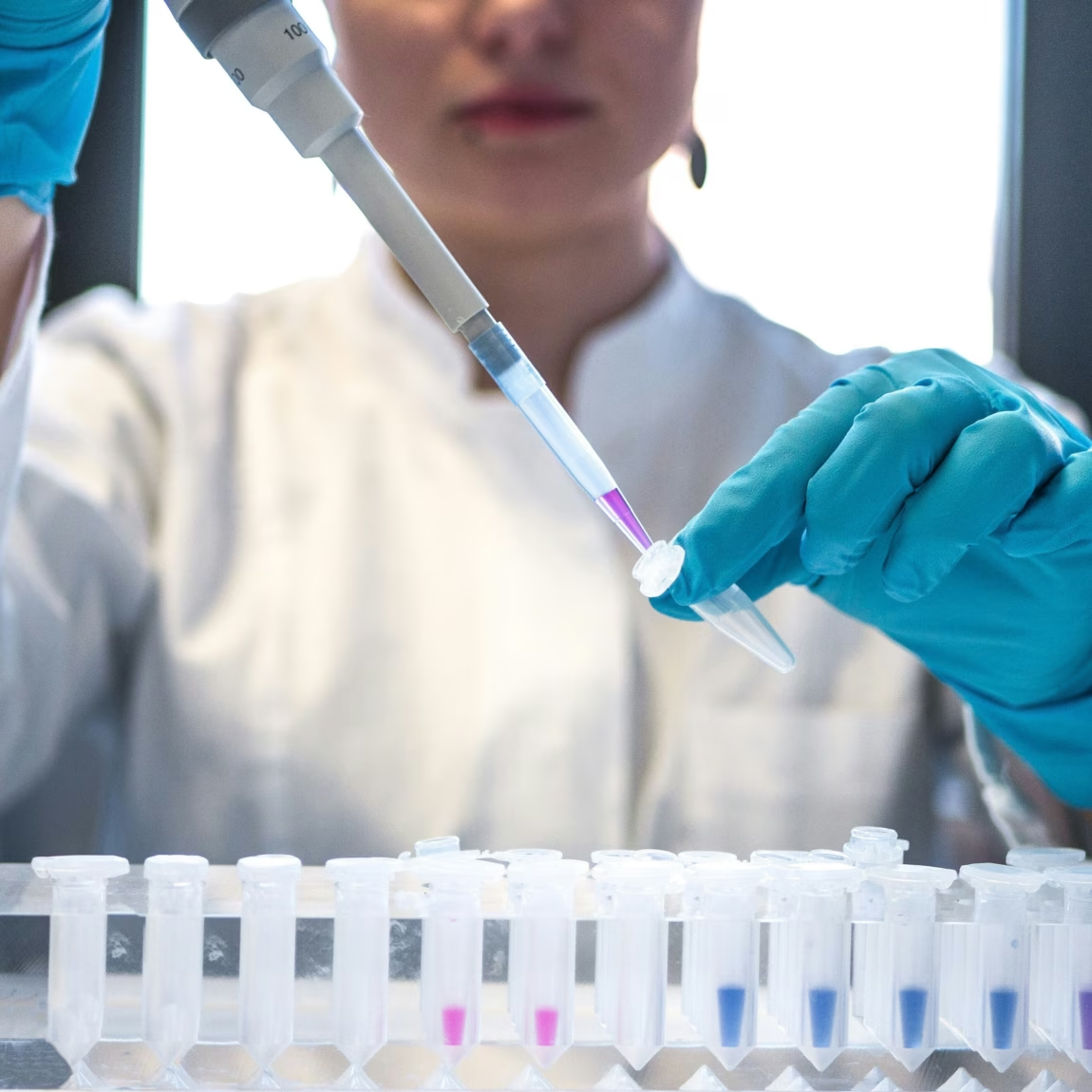
TFA differs analytically from many other PFAS compounds. Due to its small molecular structure and high solubility in water, the substance requires specific analytical methods and expertise.
Not all standard PFAS methods automatically detect TFA. That is why it is important to clearly define in advance which substances need to be tested and which analytical method is suitable for that purpose.
Proper sampling and interpretation are at least as important as the analysis itself.
How to Interpret TFA Results
An analytical result tells only part of the story. With TFA, context is crucial.
Currently, there are still limited regulatory limits for TFA in food products. As a result, a detection does not automatically indicate a food safety issue or non-compliance. At the same time, results should not simply be ignored.
When interpreting the results, the following factors, among others, must be taken into account:
- The type of product or water;
- The origin of the raw material;
- Background concentrations in the environment;
- Trends in successive analyses;
- Available scientific insights;
- Possible future regulatory developments.
This is precisely why expert interpretation is essential. A value only becomes meaningful when it is assessed within the proper context of risk analysis, exposure, and applicable regulations.
What does this mean for QA and compliance?
TFA demonstrates how rapidly the landscape surrounding PFAS is evolving. Whereas the focus a few years ago was primarily on PFOS and PFOA, attention is increasingly shifting toward a broader group of fluorinated compounds and their degradation products.
For QA professionals, this means that contaminant management is increasingly going beyond mere compliance with existing legislation. Even emerging substances for which no definitive legal limits yet exist may give rise to questions from customers, retailers, or regulators.
Organizations that already have insight into their water quality, raw material flows, and potential PFAS sources are better prepared for future developments.
What can you expect?
The discussion surrounding TFA is still in its early stages. As more measurement data becomes available and scientific insights continue to evolve, attention to this substance is likely to increase.
For food companies, this is a good time to assess which risks are relevant to their specific situation. Targeted analyses of water, raw materials, or finished products can provide valuable information and help proactively address future questions from customers and regulators.
How to Get a Handle on TFA
Are you unsure whether TFA is relevant to your products, raw materials, or water sources? Our laboratory experts are happy to assist you in conducting a risk analysis and recommend which tests are most appropriate for your specific situation. This not only gives you insight into potential exposure but also provides support in interpreting results within the context of food safety and compliance.