

Accessibility links Skip to main content

Bongkrekic acid: an underestimated but serious risk in the food chain

The recent focus on bongkrekic acid underscores that food safety is not limited to traditional microbiological hazards. For QA managers in the food industry, this is a clear wake-up call: even lesser-known, toxin-producing microorganisms can pose a significant risk, especially when they remain undetected by standard control and analysis methods.

Continue reading

Origin and formation: a process-driven risk

Bongkrekic acid is a toxin produced by Burkholderia gladioli pathovar cocovenenans, a bacterium that can develop in starchy foods under specific conditions. Scientific literature describes how the toxin primarily forms during fermentation processes or when moist, starch-rich products are stored improperly, with parameters such as temperature, water activity, and hygiene playing a decisive role (EFSA, 2012; FAO/WHO, 2023).

The formation of the toxin is highly dependent on environmental conditions. Temperature control appears to be a critical factor here: elevated temperatures stimulate both bacterial growth and toxin production. As a result, this is not a classic “product contamination problem,” but rather a process-driven risk in which even minor deviations in production or storage conditions can have major consequences.

harvest stack of ripe coconut

Impact: high toxicity and limited detectability

What makes bongkrekic acid particularly risky is the combination of extreme toxicity and the absence of sensory warning signs. The toxin is odorless, colorless, and heat-resistant, meaning it is not inactivated by standard thermal processes (WHO, 2020).

Toxicological evaluations show that bongkrekic acid disrupts mitochondrial energy production by inhibiting ADP/ATP translocase, leading to rapid cellular energy shutdown and multi-organ failure. The World Health Organization reports that exposure can result in severe poisoning with high mortality, even at low doses (WHO, 2020; FAO/WHO, 2023).

For food companies, this means that this is not a classic quality issue, but a high-impact food safety hazard with direct consequences for consumer safety and business risk.

Control: Prevention Through Process Monitoring

Because bongkrekic acid forms before consumption and cannot be removed afterward, the focus is entirely on prevention. International food safety organizations emphasize that control must primarily be achieved through monitoring of process conditions, raw materials, and storage conditions (FAO/WHO, 2023).

Strict temperature control, hygienic processing environments, and well-established supplier monitoring are essential in this regard. Additionally, cross-contamination must be avoided, as Burkholderia gladioli can spread through various routes within production environments.

Why analysis and collaboration with specialized labs are crucial

An additional challenge is that bongkrekic acid is not detectable through sensory inspection. This makes analytical monitoring a necessary complement to preventive measures, especially within high-risk matrices.

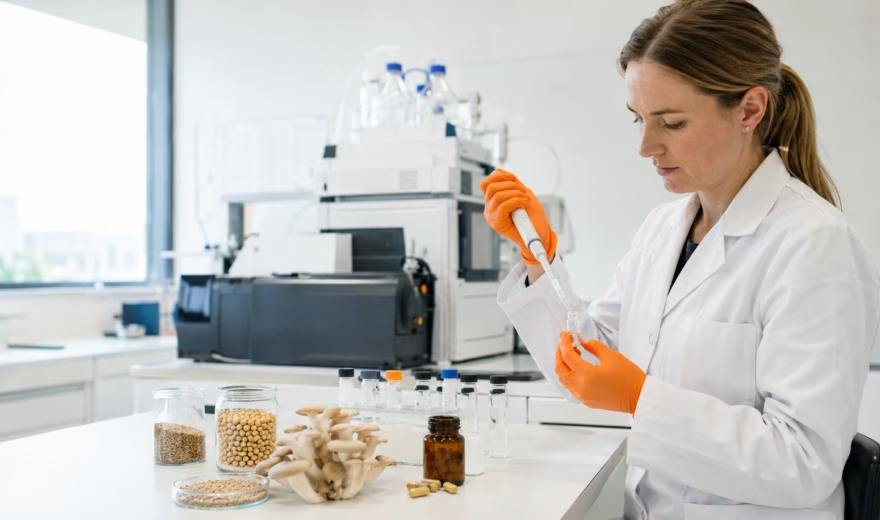
In this context, specialized laboratory expertise plays an increasingly important role. Labor Friedle (Normec Foodcare) supports the food industry with advanced analytical techniques such as LC-MS/MS, which can detect toxins and contaminants in complex matrices. This analytical capability aligns with the broader evolution in food safety, where QA systems are increasingly shifting from reactive control to proactive risk management, supported by validated laboratory data. The role of 

such laboratories are not limited to detection but also extends to the validation of control measures and the support of risk-based QA strategies.

From Awareness to Structural Control

Bongkrekic acid illustrates how new or lesser-known hazards can quickly become relevant within an international food chain. For QA managers, the challenge lies in recognizing such risks in a timely manner and translating them into concrete, process-based control measures.

By prioritizing prevention, supported by scientific insights and specialized analytical expertise, this type of risk can be effectively controlled. In an increasingly complex food chain, this integration between process control and laboratory support becomes an essential prerequisite for sustainable food safety.

Please contact us

Contact form

Name
Privacy Policy