


Accessibility links Skip to main content

In conversation with Aldo Evers on Listeria and challenge testing

Listeria has been in the news regularly recently. The coverage shows how big the consequences can be for public health, how important it is to have a good control of Listeria monocytogenes and the essential role that challenge testing plays in this. In this article, we talk to Aldo Evers - Technical Director Microbiology - about Listeria and challenge testing.

Contact us

Fill out the form and we will contact you shortly.

Name
In which country would you like to be assisted?
Privacy Policy 
Continue reading
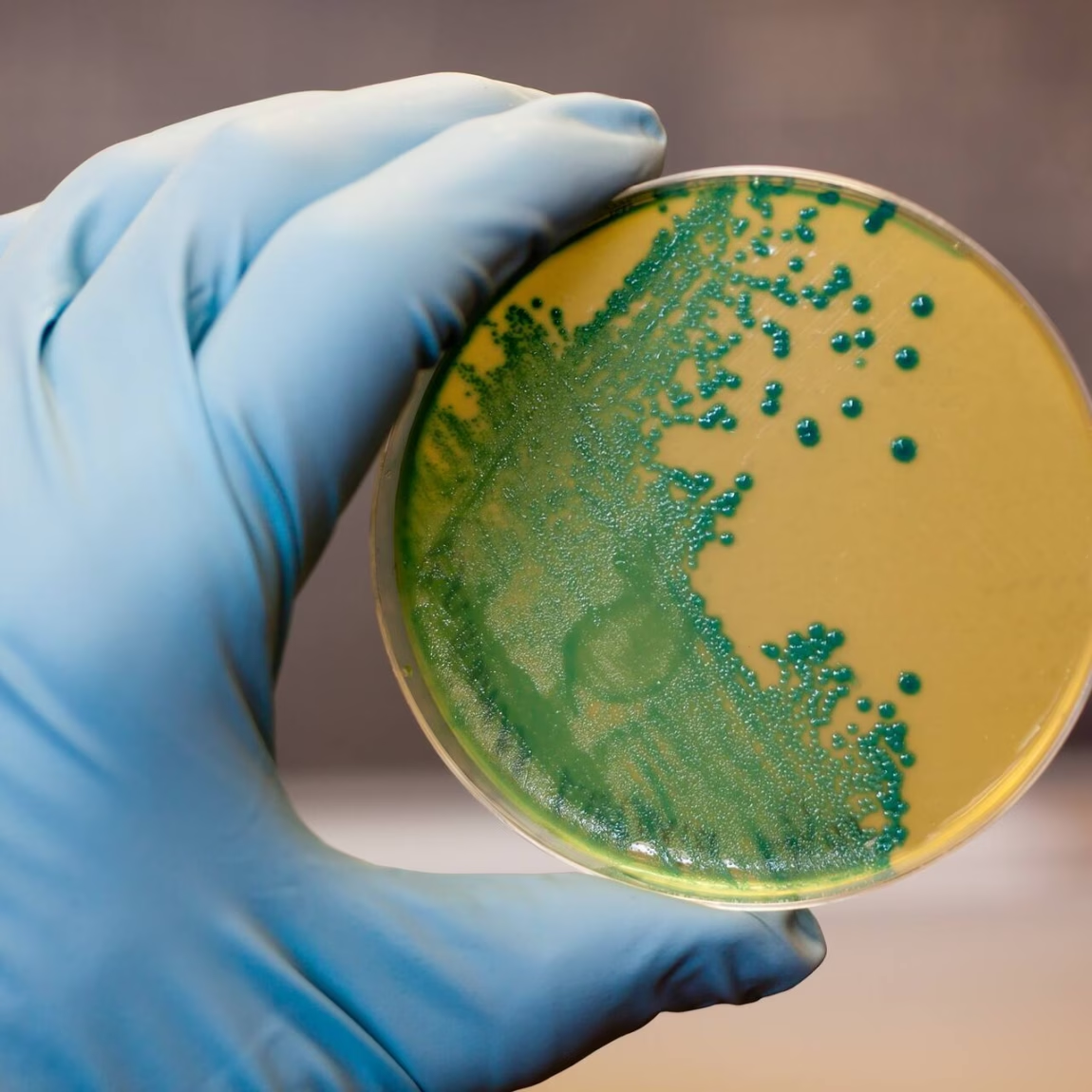
Petri dish with blue-green bacterial colonies on nutrient agar, held with a laboratory glove.

At Normec Foodcare, we perform in-depth microbiological analyses in our laboratories to ensure the safety and quality of food: from pathogen studies and research on various spoilage organisms to chemical and physical studies. Every day our laboratory specialists receive all kinds of questions about microbiological analyses and legislation, especially specifically focused on Listeria.

Aldo Evers

QA with Aldo Evers

Someone who knows all about this is Aldo Evers. As a Technical Specialist, he has experienced most of the complex situations surrounding Listeria monocytogenes and challenge testing for many years. Recently he became Technical Director Microbiology at Normec Foodcare. In a conversation with Aldo, we asked him several questions that are often asked about challenge testing.

What is a challenge test?

A challenge test is a specialized laboratory test in which we intentionally contaminate a product with a known amount of a bacterium, such as Listeria monocytogenes. We then closely monitor how that bacterium behaves in the product throughout its shelf life. This gives us a clear picture of the microbiological risk and allows us to assess whether the product remains safe and meets the legal requirements, as set out in EU Regulation 2073/2005. These tests are especially important for ready-to-eat chilled products that are consumed without further heating. In addition to Listeria, we also perform this type of testing for other pathogens such as Salmonella or Bacillus cereus.

Why are challenge tests for Listeria monocytogenes important?

Listeria monocytogenes is a notorious bacterium because it can grow even at refrigerator temperatures and cause serious infections in vulnerable groups such as pregnant women, the elderly and people with weakened immune systems. For producers of meat products, fish products and dairy products, for example, it is therefore crucial to demonstrate that their product does not allow such growth, or that the bacteria remain below the 100 cfu/g limit until the end of shelf life. This is not only a legal requirement under EU Regulation 2073/2005, but also essential for food safety and consumer confidence. Without this substantiation, a product may be deemed unsafe or certain claims may not be made.

What do companies struggle with when it comes to Listeria challenge testing?

We find that companies often struggle with several aspects. First, setting up a correct test is not simple: you have to select the right strains, determine a realistic contamination level and choose appropriate storage conditions. All these choices directly affect the value of the results. In addition, finding the right balance between a realistic but also strict enough "worst-case scenario" is a challenge.

Furthermore, practical factors play a role. Challenge tests are intensive: they often take weeks, are expensive and may only be conducted in specialized laboratories. For smaller companies, this can be a significant barrier. The interpretation of the results also often raises questions: what exactly does a small increase in Listeria mean for my shelf life and labeling?

On top of that, product variation comes into play. Small differences in pH, water activity or packaging can affect growth, so one test is not always representative of the entire production. And finally, European regulations put additional pressure on proper implementation, as you are required to demonstrate that the product remains below the limit until the end of shelf life.

Can you use alternatives to a challenge test?

There are certainly alternatives, such as predictive models that simulate the behavior of microorganisms such as Listeria (e.g., ComBase or FSSP). Alternatively, a product can be designed to exclude bacterial growth, for example, by low pH, low water activity or by using preservatives. This approach can be valuable, but is not always seen by authorities as full proof of safety. Especially with ready-to-eat products where Listeria is a real risk, a challenge test usually remains necessary.

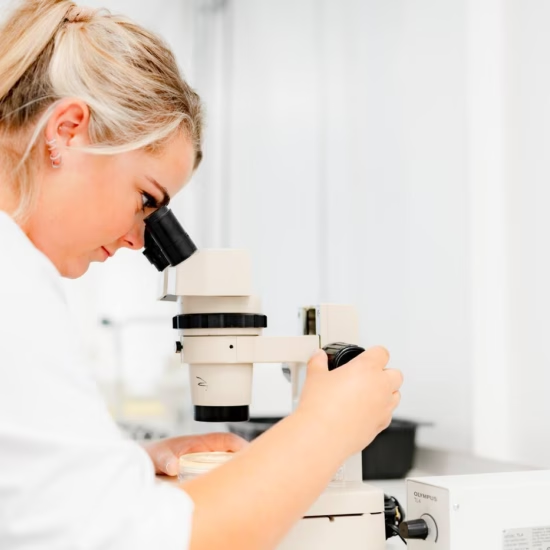
A woman is looking through a microscope at samples in a laboratory.

What can companies do to facilitate this process?

In our experience, good preparation makes all the difference. Work with specialized laboratories experienced in Listeria challenge testing and the international guidelines (such as ISO 20976-1). Use predictive models in advance to identify risks and refine the test design - this saves time and costs. Sometimes a combination of models with limited, targeted challenge testing is the most efficient approach.

In addition, we recommend that companies build sufficient knowledge internally so that results are not only interpreted correctly, but can also be effectively integrated into the food safety plan (HACCP or FSSC 22000). A laboratory that collaborates with QA experts in this brings enormous benefits. By working together smartly and bringing in the right expertise, the process can not only be faster and more cost-effective, but also more reliable and better tailored to legislation as well as the company-specific situation.

Discover the 9 control measures of Listeria monocytogenes

In the food sector, the control of Listeria monocytogenes in ready-to-eat foods remains an important issue. Besides the HACCP analysis and the necessary hygiene measures to control (post)contamination, the focus is on studies of potential contamination and the possibility of outgrowth under "worst-case" conditions. Discover in 9 steps which control measures you can take and read our white paper on Listeria monocytogenes.

Need support in the food sector?

Our experts think along with you and help you quickly on your way.

Request a quote

Fill out the form and we will contact you shortly.

Name
In which country would you like the service to be carried out?
Privacy Policy 

Related news articles

24 Jun 2025

Challenge testing in the food industry: more than just Listeria

Challenge tests are laboratory tests in which a known number of microorganisms (such as Listeria monocytogenes, Salmonella, Bacillus cereus, yeasts or fungi) are deliberately added to a food product. The product is then stored under realistic storage conditions (such as temperature, packaging and time) to observe whether and how quickly the microorganism grows, survives or dies. They aim to assess the microbiological safety or shelf life of a specific product in its real matrix and packaging. Challenge tests are best known in the context of Listeria control but have numerous other applications and assets.


A laboratory technician examines raw material samples for quality control and analysis.
13 May 2026

Listeria under control: why challenge testing is a priority now

First, it is good to set the background. Regulation 2073/2005 establishes two key criteria for Listeria in ready-to-eat foods: first, the criterion that L. monocytogenes should not be detectable in 25 g for products in which growth may occur, before the product leaves the operator; second, the limit of 100 cfu/g over the entire shelf life if growth of Listeria is shown not to occur.

23 Jan 2025

Amendment to Regulation (EU) No. 2073/2005: Listeria

On November 20, 2024, Regulation (EU) 2024/2895 was published. This amends Regulation (EC) No. 2073/2005 with regard to Listeria monocytogenes. The amendments take effect on July 1, 2026.

Sign up for our newsletter

Sign up

Naam

Related services

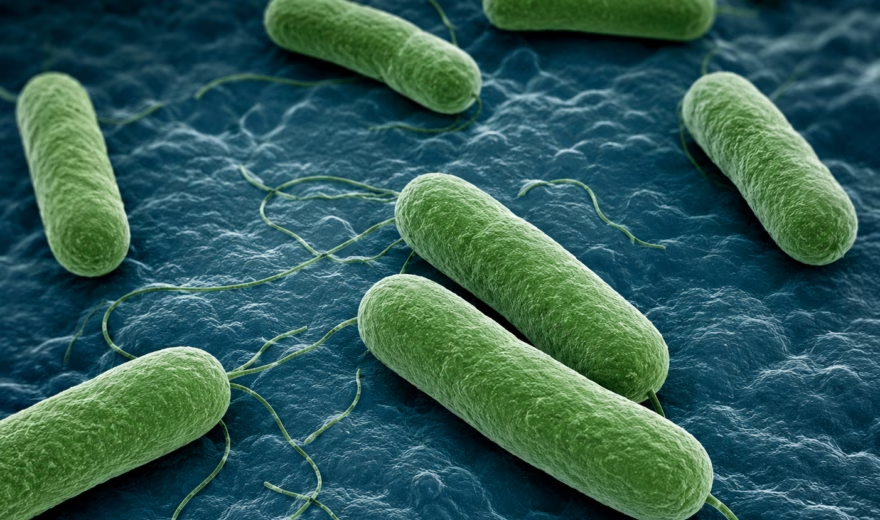
Illustration of Listeria monocytogenes, a bacterium relevant to food safety research.

Listeria research and studies

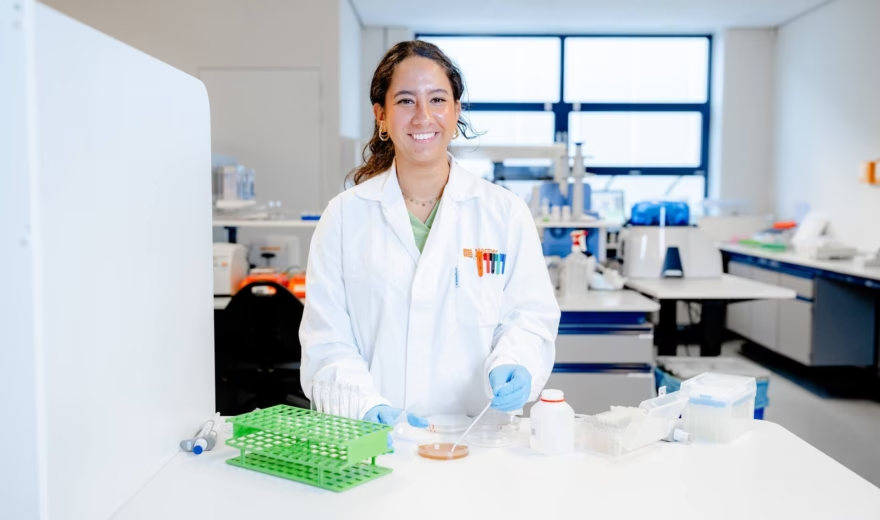
Analist in Normec Laboratorium

Analysis and monitoring

Microbiological research

Shelf life testing