Accessibility links Skip to main content

Amendment to Regulation (EU) No. 2073/2005: Listeria

On November 20, 2024, Regulation (EU) 2024/2895 was published. This amends Regulation (EC) No. 2073/2005 with regard to Listeria monocytogenes. The amendments take effect on July 1, 2026.

Contact us

Fill out the form and we will contact you shortly.

Name
In which country would you like to be assisted?
Privacy Policy 
Continue reading
Een vrouw in een witte labjas en mondkapje haalt meerdere reageerbuisjes uit een rek in een laboratorium, geconcentreerd werkend aan een experiment.

Amendment to Listeria criteria for food category 1.2: what you need to know

As a result, the European Union has aligned the Listeria criteria with the International Codex Alimentarius. The amendment applies only to food category 1.2: ready-to-eat foods that can serve as a growth medium for Listeria monocytogenes. The standards for the other categories—namely, ready-to-eat infant formula, ready-to-eat food for medical use, and ready-to-eat foods that cannot serve as a breeding ground—remain unchanged.

Until now, Listeria was not permitted to be detected in 25g within this category before the food left the direct control of the food business operator that produced it. After the transition period, Listeria must not be detected in 25g throughout the entire shelf life unless a study (in Belgium and the Netherlands, challenge tests are used for this study, among other methods) is approved by the authorities (FAVV/NVWA) that demonstrates the standard of <100 CFU/g at the end of the shelf life will not be exceeded.

A transition period gives operators time to implement new testing protocols and take any necessary measures before the legislation takes effect. This will take effect on July 1, 2026. Our consultants, in collaboration with our Listeria team, can assist you with this.


Need support in the food sector?

Our experts are happy to work with you and get you started quickly.

Request a quote

Fill out the form and we will contact you shortly.

Name
In which country would you like the service to be carried out?
Privacy Policy 

Related news articles

Close-up of oil droplets in a liquid for analysis of composition and quality.
25 May 2026

MOSH and MOAH in food: causes and prevention

The presence of MOSH and MOAH is not an isolated problem, but the result of multiple possible contamination pathways in the chain. Products with a high absorption capacity or fat matrix are especially susceptible. Cereals, rice, cocoa, nuts, vegetable oils and chocolate are among the high-risk products, in part because these products readily absorb and retain MOSH. MOAH receives extra attention here because of possible genotoxic and carcinogenic properties.

Recording of quality data during an inspection in a production environment.
25 May 2026

Effective training in the food industry: from planning to impact

For QA managers in the European food industry, training has long since ceased to be a "nice to have," but a crucial building block for food safety, compliance and continuous improvement. Topics such as allergen management require up-to-date knowledge, but equally important is how that knowledge is transferred, secured and applied on the shop floor. A well-thought-out training strategy - cleverly combining different forms of learning - makes the difference between merely informing and actually changing behavior.

Inspection and examination of plants in a controlled growing environment for quality and cultivation management.
25 May 2026

Normec Groen Agro Control at GreenTech 2026

From 9 to 11 June, Normec Groen Agro Control will be present at the GreenTech exhibition at RAI Amsterdam. During this international trade fair for horticulture technology, we will engage with professionals from the agri, horticulture, and food supply chain on current challenges related to quality and food safety.

25 May 2026

New French MRL law as catalyst for stricter marketing standards

With the recent introduction of stricter national residue standards, France has reignited the debate over Maximum Residue Levels (MRLs) in the European Union. Whereas the EU has had a harmonized system for pesticide residues in food for many years, France is now opting for additional national restrictions for specific active substances. This development has direct implications for companies importing agricultural products to France or exporting from France.

A laboratory technician examines raw material samples for quality control and analysis.
13 May 2026

Listeria under control: why challenge testing is a priority now

First, it is good to set the background. Regulation 2073/2005 establishes two key criteria for Listeria in ready-to-eat foods: first, the criterion that L. monocytogenes should not be detectable in 25 g for products in which growth may occur, before the product leaves the operator; second, the limit of 100 cfu/g over the entire shelf life if growth of Listeria is shown not to occur.

Hands cupped under running water from a natural spring.
11 Feb 2026

PFAS in drinking water: new standard from January 2026

The introduction of mandatory PFAS monitoring in drinking water marks an important turning point for water quality within the European Union. Starting in early 2026, all member states will have to systematically test for per- and polyfluoroalkyl substances, known as PFAS, some of which are among the most persistent and chemicals of concern known to man. The new standards, set forth in the revised EU Drinking Water Directive (Directive (EU) 2020/2184), are intended to better protect consumers from chronic exposure through tap water and water used in food production and processing.

04 Feb 2026

The importance of trend analysis in the food industry: from data to strategic decisions

Huge amounts of data are collected daily in the food industry: analysis results, audit findings, complaints, KPIs and more. Yet this information often persists in silos without moving forward: trend analyses. It is precisely these analyses that make the difference between reactive firefighting and proactive management of quality and food safety.

Sign up for our newsletter

Sign up

Naam

Related services

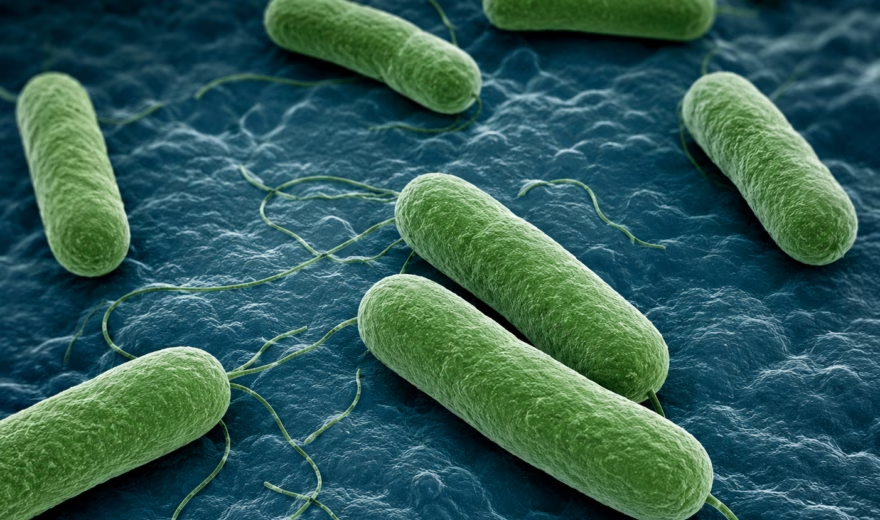
Illustration of Listeria monocytogenes, a bacterium relevant to food safety research.

Listeria research and studies

Shelf life testing

Microbiological research

Food safety risk scan