Accessibility links Skip to main content

New French MRL law as catalyst for stricter marketing standards

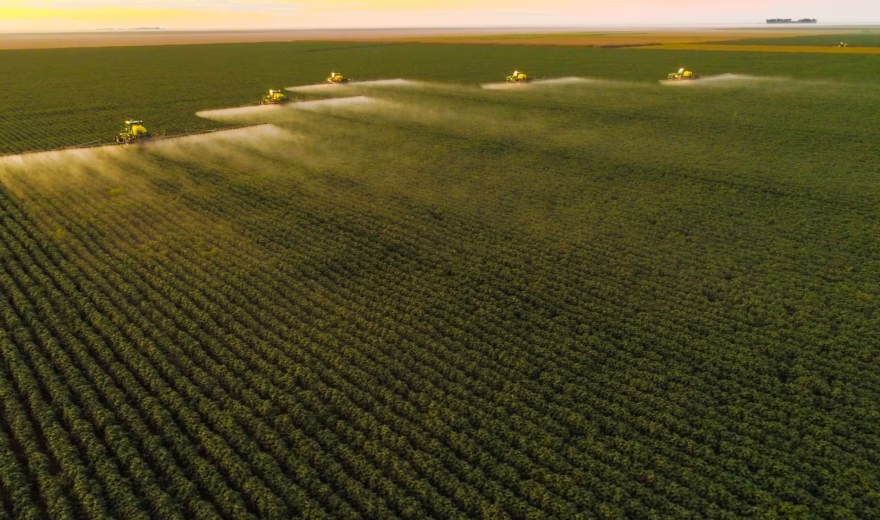
With the recent introduction of stricter national residue standards, France has reignited the debate over Maximum Residue Levels (MRLs) in the European Union. Whereas the EU has had a harmonized system for pesticide residues in food for many years, France is now opting for additional national restrictions for specific active substances. This development has direct implications for companies importing agricultural products to France or exporting from France.

What are MRLs and why are they important?

Maximum Residue Levels (MRLs) indicate the maximum allowable amounts of pesticide residues that may be present in or on food or feed. They are expressed in milligrams per kilogram (mg/kg) and are based on the premise that an agent is properly applied according to Good Agricultural Practice.

MRLs serve two purposes. They protect public health by preventing consumers from ingesting harmful amounts of pesticides. At the same time, they ensure a level playing field within the internal market by setting uniform standards for all member states and for imported products. When no specific MRL is set for a substance, a default value of 0.01 mg/kg applies within the EU, which in practice corresponds to the analytical detection limit.

The European legislative framework for MRLs The setting and harmonization of MRLs within the EU is governed by Regulation (EC) No. 396/2005 of the European Parliament and of the Council of February 23, 2005 on maximum residue levels of pesticides in or on food and feed of plant and animal origin. This regulation is the centerpiece of European residue policy and is directly applicable in all member states.

The legislation provides for a science-based decision-making process. The European Food Safety Authority (EFSA) carries out the risk assessment, which includes an assessment of toxic properties, exposure scenarios and consumption patterns. Based on this assessment, the European Commission, in consultation with the member states, sets new MRLs or adjusts existing values.

In addition, the European system has import tolerances. This means that for substances that are not or no longer allowed within the EU, a specific MRL can still be set for products from third countries, provided that EFSA concludes that the residue values are safe for consumers.

The new French measure and the substances concerned

France has recently taken the opportunity to set stricter requirements at the national level, specifically for imported agricultural products, by publishing the Arrêté du 5 janvier 2026 portant suspension d'importation, d'introduction et de mise sur le marché à titre gratuit ou onéreux, en France, de denrées alimentaires provenant de pays tiers à l'Union européenne contenant des résidus de certaines substances actives phytopharmaceutiques interdites d'utilisation dans l'Union européenne.

This measure targets four active substances: carbendazim (including benomyl), thiophanate-methyl, glufosinate and mancozeb. For these substances, France has practically reduced permitted residue levels to the level of the analytical quantification limit (LOQ). This means that residues are effectively no longer allowed to be detectable in products placed on the French market. This applies to fruits, vegetables, cereals, soybeans and honey, among others.

What is special about this French approach is that in some cases it goes beyond current EU MRLs, particularly where import tolerances still exist at the EU level. As a result, a product that fully meets European residue standards can still not be allowed on the French market if residues of these specific substances are found above the LOQ.

Why is France taking a stricter approach?

The French government justifies its decision with the precautionary principle and health risks of substances no longer approved within the EU. Although some residues are still permissible under EU rules through import tolerances, France wants to offer consumers additional protection.

In addition, the social and political climate in France plays a role. There is strong public and political pressure to further reduce chemical risks in the food chain. The national measure can be seen as a stricter national interpretation of consumer protection within the framework of European legislation.

Impact on imports and exports to France

The practical impact of the French measure is significant. For importers of products from third countries, it means that they can no longer rely solely on compliance with EU MRLs. They must demonstrate that products for the French market are free of residues of the substances in question above the detection limit. This will require tightened contracts with suppliers, additional laboratory analyses and possibly adjustment of cultivation practices in the country of origin.

Additional obligations also arise for EU exporters when delivering to France. Although products can circulate freely in other member states, France may carry out additional checks upon entry. This results in additional administrative burdens and a higher risk of trade barriers.

For international trading partners, the French measure may trigger discussions within WTO rules, as differences between EU harmonization and national additions affect the predictability of market access.

The French MRL measure illustrates that harmonization within the EU does not preclude Member States from imposing stricter national requirements in exceptional circumstances. Although the EU provides a uniform residue framework through Regulation (EC) No. 396/2005, there remains room for national intervention when Member States wish to provide additional public health protection.


The importance of thorough analyses

The French measure emphasizes the crucial importance of reliable residue analyses for companies that import or export agricultural products. Only by systematically testing and demonstrably documenting that residues of highly regulated substances remain below the detection limit can national and European regulations be met. Analyses are thus not only a means to ensure food safety, but also a strategic tool to mitigate trade risks, maintain market access and strengthen confidence among buyers. Without adequate monitoring and laboratory testing, products conforming to EU MRLs may be rejected in France, resulting in economic losses and reputational damage.

Achieve a safe and healthy working and living environment?

Normec tests, inspects and certifies so that organizations can innovate safely, quickly and cost-effectively.

Contact us

Contact form

Name
Privacy Policy