Accessibility links Skip to main content

Sustainable Packaging: The Underestimated Risks to Shelf Life and Food Safety

The shift toward sustainable packaging is in full swing. Companies are flocking to recyclable solutions, single-material options, and packaging designs that better align with European recycling targets. This evolution is both logical and necessary.

Contact us

Fill out the form and we will contact you shortly.

Name
In which country would you like to be assisted?
Privacy Policy 
Continue reading

What QA Professionals in the Food Industry Need to Watch Out For

The shift toward sustainable packaging is in full swing. Companies are flocking to recyclable solutions, single-material options, and packaging designs that better align with European recycling targets. This evolution is both logical and necessary.

But behind this sustainability facade lies a less visible issue: what does this mean in concrete terms for food safety, shelf life, and product stability?

This creates a new balancing act for QA professionals. Sustainability must not come at the expense of product integrity. And that is precisely where often underestimated risks arise in practice.

Where do things often go wrong? The main pitfalls

Barrier loss is detected too late

One of the most significant changes when switching to recyclable or mono-material packaging is the impact on barrier properties. Traditional multilayer packaging typically offers strong protection against oxygen, moisture, and aromas. Single-material packaging is more recyclable but does not always achieve the same level of performance.

In practice, this leads to subtle but significant shifts in product behavior. For example, higher oxygen permeability can accelerate oxidation, while a reduced moisture barrier affects texture and stability. Aromas can also be lost or migrate more quickly, which is noticeable in the product’s sensory properties.

The result is not necessarily an immediate safety issue, but it does have a clear impact on shelf life and product quality.

New packaging, old shelf life: a risky mismatch

A classic pitfall: the packaging changes, but the shelf life remains unchanged.

Many companies still rely on historical shelf-life data without revalidating it for the new packaging situation. This is risky, because even small changes in barrier properties can accelerate microbiological or chemical changes.

For QA, this means that every packaging change must automatically raise the question:
Is our current shelf life still scientifically substantiated?

Migration risks are underestimated

New sustainable materials are often combined with different raw materials, additives, or coatings, which increases the complexity of migration assessment. Furthermore, with mono-materials or packaging containing recycled content, variations in composition may occur, which can impact both overall and specific migration, as well as the presence of NIAS (Non-Intentionally Added Substances).

Without a sufficiently substantiated evaluation and testing, this can lead to unexpected compliance challenges, especially in highly regulated markets.

Design for Recycling vs. Product Protection: Where the Tension Lies

In many organizations, there is a strong emphasis on “design for recycling,” which is a logical and positive evolution from a sustainability perspective. However, this approach must not be viewed in isolation from food safety and product protection.

A packaging solution may be perfectly recyclable, but at the same time less suitable for applications involving sensitive products such as high-fat or moist foods, for long distribution chains, or for refrigerated and frozen products.

The real challenge, therefore, lies in finding the right balance between circular economy goals and ensuring product quality and safety.
What does this mean for QA professionals?

For QA, the role is increasingly shifting from post-production inspection to risk-based pre-production validation. Packaging is no longer a static factor but a variable that directly impacts product safety and shelf life. This calls for a more integrated approach in which packaging selection, product formulation, shelf life, and compliance are considered together.

Step-by-Step Guide: How to Avoid Surprises with Sustainable Packaging

  1. 1.

    Step 1: Start with a packaging risk analysis

    For each product, identify which barrier properties are critical (oxygen, moisture, light, aroma). Link this to product sensitivity and distribution conditions.

  2. 2.

    Step 2: Compare the performance of old and new packaging

    Objectively compare technical data (OTR, WVTR, mechanical properties) between existing and new packaging. Do not rely solely on supplier claims; validate them analytically or through testing where necessary.

  3. 3.

    Step 3: Review shelf-life data

    Conduct an impact analysis of existing shelf-life studies. In the event of significant packaging changes, revalidation via challenge tests or real-time studies is often necessary.

  4. 4.

    Step 4: Conduct migration and compliance evaluations

    Verify that new materials comply with all relevant food contact regulations, including potential NIAS risks and variability in recycled streams.

  5. 5.

    Step 5: Test under realistic conditions

    Combine laboratory data with real-world conditions, such as temperature variations, transport stress, and consumer use. This is the only way to get a realistic picture of performance.

  6. 6.

    Step 6: Ensure documentation and traceability

    Ensure that all decisions, test results, and supporting evidence are properly documented. This is essential for audits, customers, and future product changes.

From sustainable to demonstrably safe

Sustainable packaging has become standard practice in the food industry. The challenge lies not in the transition itself, but in demonstrating that food safety, shelf life, and product quality are maintained.

For QA professionals, it is not realistic to conduct extensive migration analyses for every change. It is better to focus on a risk-based approach in which packaging changes are properly validated and verified based on product characteristics and conditions of use.

We support companies in this process with an integrated approach to packaging changes and shelf-life studies. Where necessary, we supplement this with targeted testing, such as shelf-life studies and challenge tests, to objectively substantiate the impact of new packaging.

In this way, sustainability becomes not only a choice but also a demonstrably safe solution.

Need support in the food sector?

Our experts think along with you and help you quickly on your way.

Request a quote

Fill out the form and we will contact you shortly.

Name
In which country would you like the service to be carried out?
Privacy Policy 

Related news articles

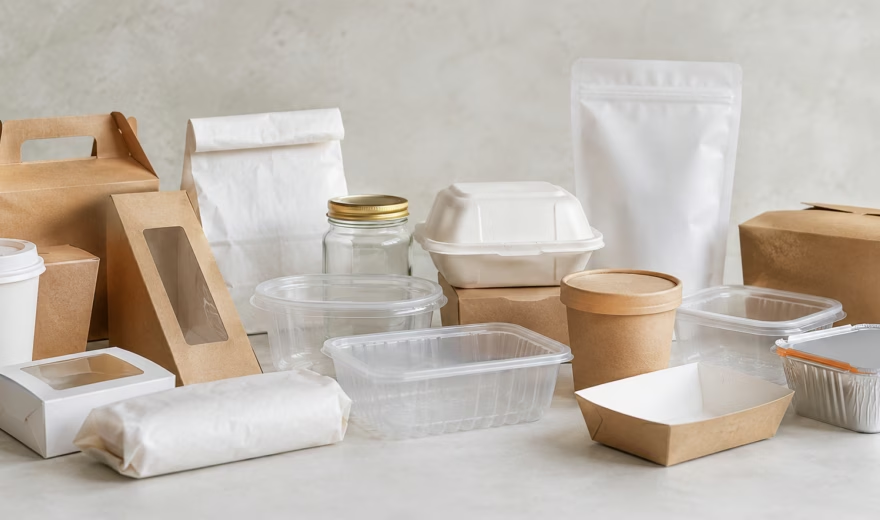
Various food packaging materials, suitable for quality and sustainability testing.
12 Aug 2026

The PPWR now applies: what does this mean for your packaging?

The European Packaging and Packaging Waste Regulation (PPWR) has applied since 12 August 2026. This marks the start of an important new phase for every organisation that manufactures, imports, uses or places packaging on the European market. The Regulation introduces stricter requirements covering substances of concern, recyclability, material use, reuse and the evidence needed to demonstrate compliance. For food businesses, this is no longer a distant development. The first obligations already apply, with further requirements being introduced in phases over the coming years. It is therefore essential to understand your packaging portfolio and determine in good time where changes are needed.

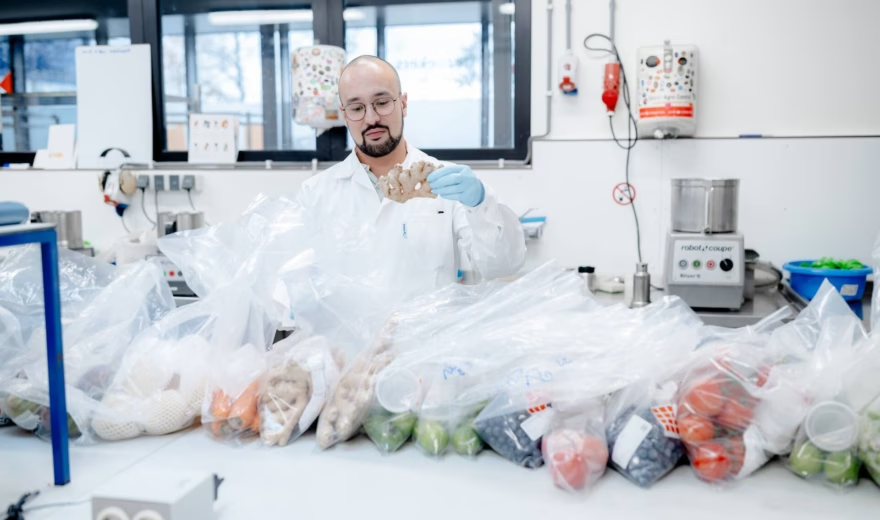
A laboratory technician examines raw material samples for quality control and analysis.
13 May 2026

Listeria under control: why challenge testing is a priority now

First, it is good to set the background. Regulation 2073/2005 establishes two key criteria for Listeria in ready-to-eat foods: first, the criterion that L. monocytogenes should not be detectable in 25 g for products in which growth may occur, before the product leaves the operator; second, the limit of 100 cfu/g over the entire shelf life if growth of Listeria is shown not to occur.

23 Jun 2026

PFAS in Packaging: Why Analytical Evidence Is Becoming Increasingly Important

PFAS have been high on the European agenda for several years now. While attention used to be focused primarily on drinking water, soil contamination, and industrial emissions, the focus is increasingly shifting to packaging materials that come into contact with food.

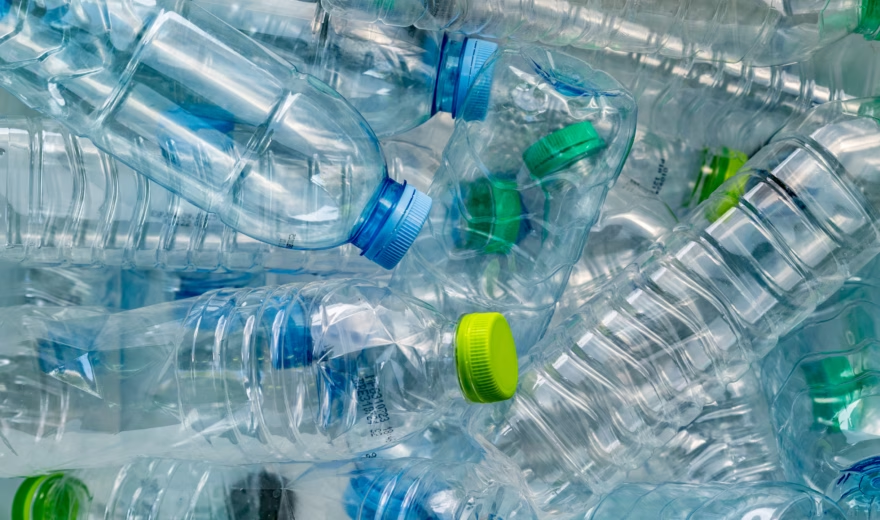
Compressed plastic bottles represent a stream of recyclable packaging material.
22 Jun 2026

Q&A with the Expert: Everything You Need to Know About the PPWR

The Packaging and Packaging Waste Regulation (PPWR) marks a significant change in European packaging legislation. The new rules affect not only packaging manufacturers but also the entire supply chain, including food companies and QA teams. What exactly does the PPWR entail? What specific changes will there be for food contact materials? And how can your organization prepare for this? We asked an expert in food contact materials and packaging compliance.

Sign up for our newsletter

Sign up

Naam

Related services

Food safety advice

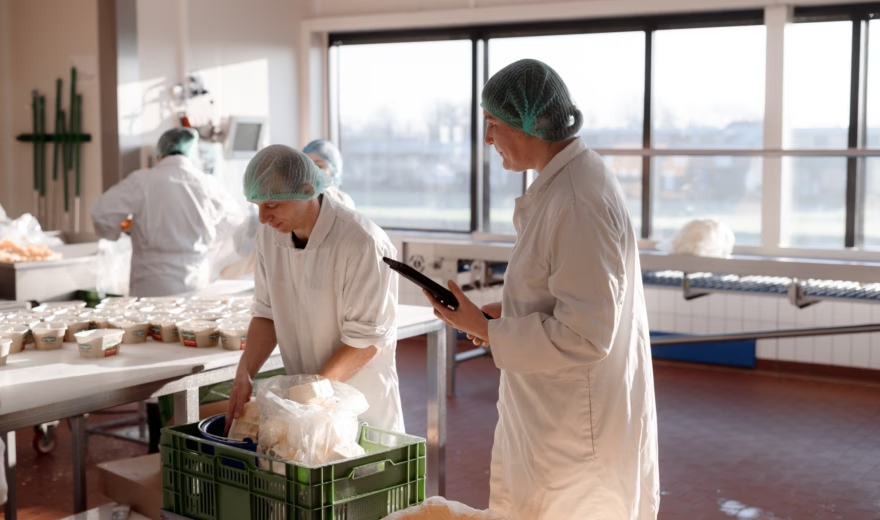
Quality control and documentation of production processes in a processing environment.

Packaging & Packaging Waste Regulation (PPWR)

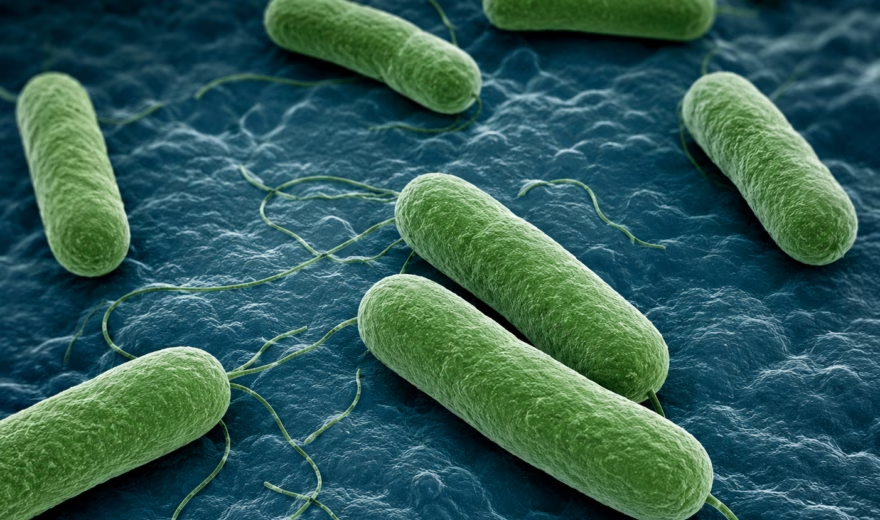
Illustration of Listeria monocytogenes, a bacterium relevant to food safety research.

Listeria research and studies

Shelf life testing