Accessibility links Skip to main content

The PPWR now applies: what does this mean for your packaging?

Contact

Fill out the form and we will contact you shortly.

Name
Privacy Policy 
Continue reading

The European Packaging and Packaging Waste Regulation (PPWR) has applied since 12 August 2026. This marks the start of an important new phase for every organisation that manufactures, imports, uses or places packaging on the European market. The Regulation introduces stricter requirements covering substances of concern, recyclability, material use, reuse and the evidence needed to demonstrate compliance.

For food businesses, this is no longer a distant development. The first obligations already apply, with further requirements being introduced in phases over the coming years. It is therefore essential to understand your packaging portfolio and determine in good time where changes are needed.

What is the PPWR?

The PPWR is the new European regulation on packaging and packaging waste. It largely replaces the previous EU Packaging and Packaging Waste Directive and applies directly in every EU Member State. It creates a single, harmonised European framework for the entire packaging life cycle: from design and production to use, reuse and waste management.

Its main objectives are to:

  • reduce packaging waste;
  • reduce unnecessary material use;
  • improve packaging recyclability;
  • encourage reuse and refill solutions;
  • increase the share of recycled content;
  • restrict substances of concern in packaging;
  • harmonise labelling and consumer information across the EU.

The PPWR applies to almost all packaging, regardless of the material used. It therefore affects not only packaging manufacturers, but also food producers, brand owners, importers, retailers and distributors.

What takes effect on August 12, 2026?

Although many of the PPWR’s targets are set for 2030, parts of the Regulation have applied since 12 August 2026. One particularly important change for the food industry is the restriction of PFAS in food-contact packaging.

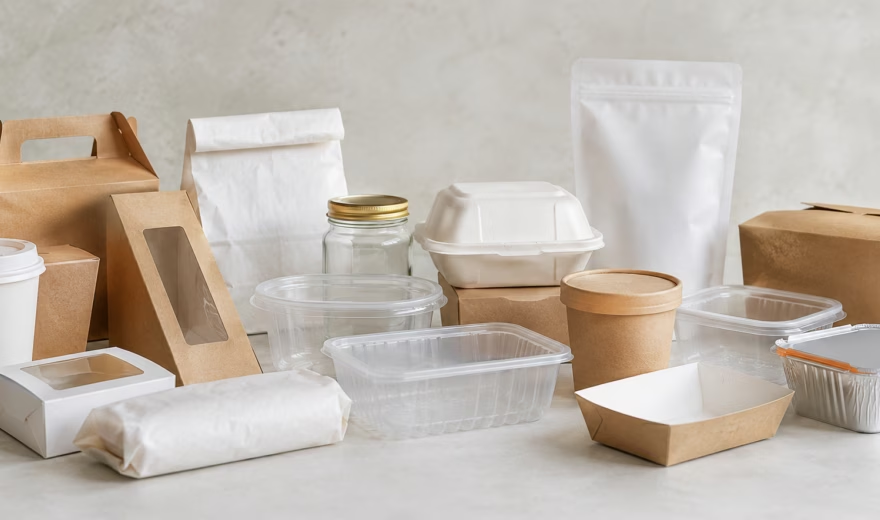
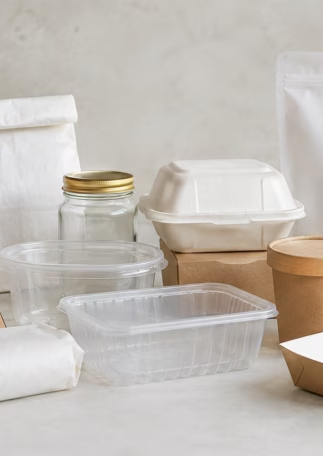
Food-contact packaging containing PFAS at concentrations equal to or above the specified limits may no longer be placed on the European market. This is particularly relevant to grease- and water-resistant packaging such as baking paper, pizza boxes, fast-food packaging, snack packaging and other coated materials.

Demonstrable compliance is also becoming increasingly important. Depending on an organisation’s position in the supply chain, businesses must be able to substantiate that their packaging meets the applicable requirements. Relevant evidence may include:

  • up-to-date material and product specifications;
  • supplier information and declarations;
  • technical documentation;
  • a substantiated conformity assessment;
  • an EU declaration of conformity where required;
  • analytical evidence when documentation alone does not provide sufficient assurance.

A supplier declaration remains an important starting point, but it is not always sufficient. Packaging may consist of several materials, coatings, inks, adhesives and additives. As a result, it is not always immediately clear which substances are present or which party in the supply chain holds the necessary information.
Which requirements will follow in the coming years?

The PPWR is being introduced in stages. Businesses therefore need to consider not only the requirements that apply today, but also those that will influence future packaging decisions.

Key developments include:

Harmonised labelling

A harmonised European packaging labelling system will be introduced from 2028. It is intended to give consumers clearer information about packaging composition and the correct waste stream.

Recyclable packaging

From 2030, packaging must be designed for recycling and will be assessed against European recyclability performance grades. From 2035, it must also be demonstrated that packaging can be collected, sorted and recycled at scale.

Recycled content

Minimum recycled-content percentages will apply to several types of plastic packaging from 2030. The exact requirements depend on factors including the packaging type and its application. Exemptions or specific provisions apply to certain food-contact packaging and other categories.

Less and more efficient packaging

Packaging must be limited to the weight and volume necessary to perform its function. From 2030, filled grouped packaging, transport packaging and e-commerce packaging may, in principle, contain no more than 50% empty space.

Reuse and refill

The Regulation introduces reuse and refill obligations in phases. These affect, among other things, transport packaging, grouped packaging, certain beverage packaging and takeaway packaging.

Restrictions on certain packaging formats

From 2030, restrictions or bans will apply to specific packaging categories, including certain single-use plastic packaging formats and individual portion packaging.

What does this mean for your organisation?

The impact of the PPWR varies from one organisation to another. Your obligations depend on your role in the supply chain, the type of packaging, the material used and how the packaging is placed on the European market.

Nevertheless, every organisation can take several practical steps now:

  1. Map your complete packaging portfolio.
  2. Determine your role and responsibility in the supply chain for each packaging item.
  3. Collect material information, specifications and supplier documentation.
  4. Identify higher-risk packaging, such as coated food-contact materials.
  5. Assess both the current and future compliance of your packaging.
  6. Set priorities in a concrete action plan for 2028, 2030 and 2035.

Waiting until every detail has been finalised creates risks. Adapting packaging, qualifying alternative materials, carrying out testing and changing supplier agreements can take considerable time. Retailers and customers may also request additional information or evidence before the legal deadlines.

From regulation to a practical action plan

Normec Foodcare helps organisations translate the PPWR into concrete, achievable actions. We map your packaging, processes and responsibilities and identify risks and missing information.

Depending on your situation, we can support you with:

  • intake and scope definition;
  • packaging portfolio mapping;
  • compliance and gap analyses;
  • reviews of specifications and supplier documentation;
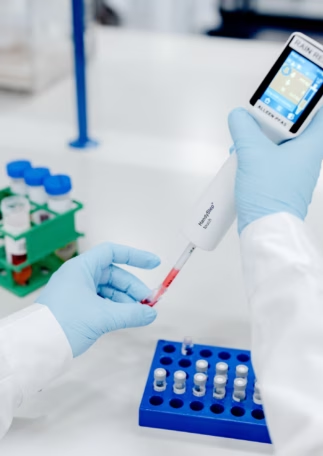
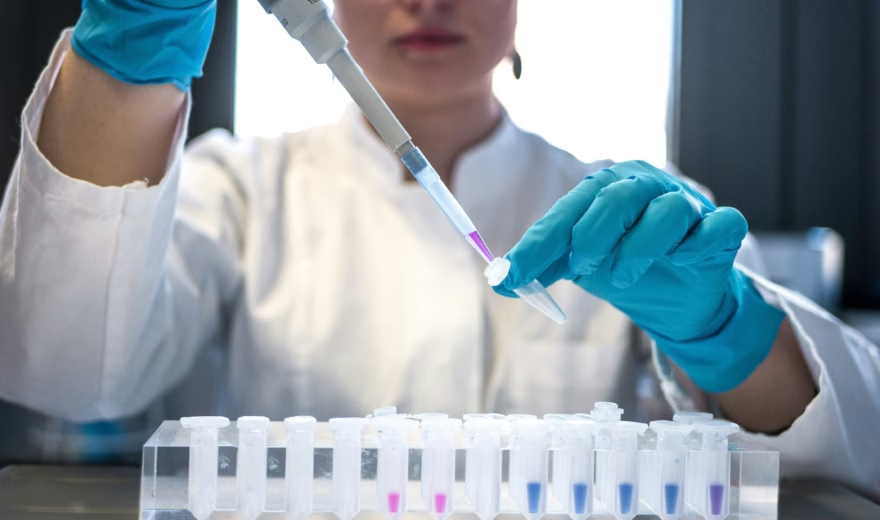
  • PFAS testing of food-contact packaging;
  • advice on material choices and packaging optimisation;
  • a phased roadmap towards future PPWR requirements;
  • practical implementation support.

This gives you more than an overview of what the PPWR requires. It shows what the Regulation means in practice for your organisation and which actions should come first.

Do you know yet whether your packaging complies?

The PPWR is no longer simply something to prepare for: its first obligations now apply. This is the time to establish where your organisation stands.

Would you like to know which PPWR requirements apply to your packaging, where your main risks lie and which actions to prioritise? Our specialists can support you with an intake, compliance analysis or targeted advice.