Accessibility links Skip to main content

New Royal Decree in Belgium for single-use plastics

As a result of the European legislation on single-use plastics (SUPs), the member states themselves have the freedom to implement the measures required to achieve the European objective. On July 5, 2024, Belgium therefore published the Royal Decree of May 25, 2024 on Single-use plastics. This RD aims to limit the marketing of certain single-use products and increase the recycled content of certain products.

Contact us

Fill out the form and we will contact you shortly.

Name
In which country would you like to be assisted?
Privacy Policy 
Continue reading

Phases of implementation and measures

To make it feasible for operators to comply with the new rules, implementation will be phased. The phases below are envisaged:

Already in effect

  • 10 days after publication of the decree, serving beverages for immediate consumption in disposable cups made entirely of plastic will be prohibited.

By January 2025

  • 6 months after publication, plastic wrappers for unaddressed printed advertising more than 15 cm wide will be banned.

As of January 2026

  • Beverage and food for immediate consumption or for take-a-way in disposable cardboard cups or containers consisting of at least 10% plastic (measured by weight) will be banned.

By January 2028

  • Beverage and food for immediate consumption or for take-a-way in disposable cups or containers consisting of at least 8% plastic (measured by weight) will be prohibited.
  • Plastic wrappers for unaddressed advertising materials of any size will be banned.

By January 2030

  • Beverage and food for immediate consumption in disposable cups and containers consisting of at least 3% plastic (measured by weight) will be banned.
  • Beverage and food for take-a-way in disposable cups and containers consisting of at least 6% plastic (measured by weight) will be prohibited.

Where can the information be checked?

Appendix 1

Describes the plastic products for which there is a minimum recycled content requirement to be allowed on the market. This takes into account that there are enough alternatives of products that have the requested recycled content.

Appendix 2

Describes plastic products that are prohibited because there is a high probability that they will end up in litter or not in the proper recycling channel, due to size or the way they are commonly used.

  • Plastic sticks and skewers between 1 and 30 cm, intended for holding a food product, excluding medical applications.
  • Cutlery and plates that do not contain plastic, except those that can be composted at home.
  • Unaddressed plasticized advertising material.

The RD states that percentages may be waived if it is confirmed that they are not possible for reasons of food safety or availability of packaging on the market. If for this reason the date is postponed, a new evaluation by independent experts will follow biennially for the category in question.

Need support in the food sector?

Our experts are happy to think with you and help you quickly on your way.

Request a quote

Fill out the form and we will contact you shortly.

Name
In which country would you like the service to be carried out?
Privacy Policy 

Related news articles

Compressed plastic bottles represent a stream of recyclable packaging material.
22 Jun 2026

Q&A with the Expert: Everything You Need to Know About the PPWR

The Packaging and Packaging Waste Regulation (PPWR) marks a significant change in European packaging legislation. The new rules affect not only packaging manufacturers but also the entire supply chain, including food companies and QA teams. What exactly does the PPWR entail? What specific changes will there be for food contact materials? And how can your organization prepare for this? We asked an expert in food contact materials and packaging compliance.
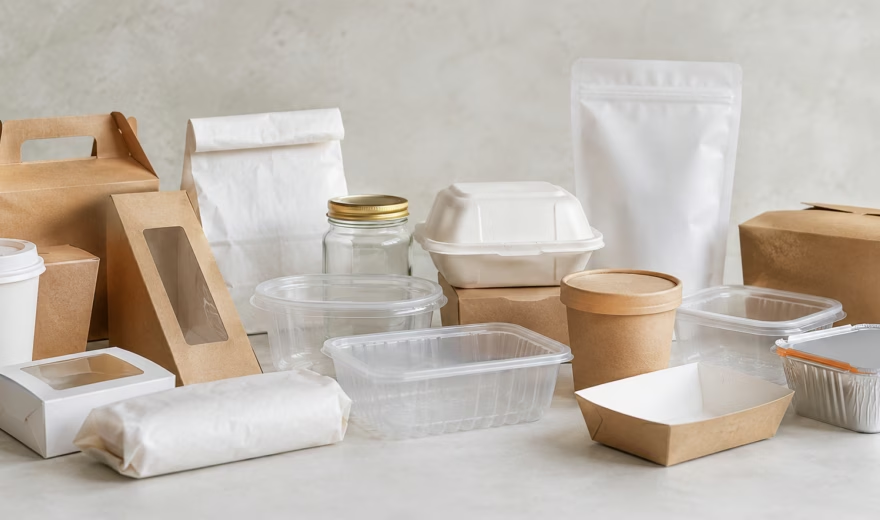
Various food packaging materials, suitable for quality and sustainability testing.
12 Aug 2026

The PPWR now applies: what does this mean for your packaging?

The European Packaging and Packaging Waste Regulation (PPWR) has applied since 12 August 2026. This marks the start of an important new phase for every organisation that manufactures, imports, uses or places packaging on the European market. The Regulation introduces stricter requirements covering substances of concern, recyclability, material use, reuse and the evidence needed to demonstrate compliance. For food businesses, this is no longer a distant development. The first obligations already apply, with further requirements being introduced in phases over the coming years. It is therefore essential to understand your packaging portfolio and determine in good time where changes are needed.

23 Jun 2026

PFAS in Packaging: Why Analytical Evidence Is Becoming Increasingly Important

PFAS have been high on the European agenda for several years now. While attention used to be focused primarily on drinking water, soil contamination, and industrial emissions, the focus is increasingly shifting to packaging materials that come into contact with food.

23 Jun 2026

Sustainable Packaging: The Underestimated Risks to Shelf Life and Food Safety

Sustainable packaging: the underestimated risks to shelf life and food safety

Sign up for our newsletter

Sign up

Naam

Related services

Food safety advice

Quality control and documentation of production processes in a processing environment.

Packaging & Packaging Waste Regulation (PPWR)

QA outsourcing food