

Accessibility links Skip to main content

Taste and packaging as risk factors?

In the food industry, risk-based thinking is pretty much a given. Standards such as IFS and BRCGS expect you as a company to systematically identify, analyze and manage risks. Contamination, allergens and microbiological hazards are thoroughly analyzed as part of a robust quality management system. Yet two essential risks often remain underexposed in classic risk analyses: consumers' reaction to the finished product - and their expectations based on the packaging.

Contact us

Fill out the form and we will contact you shortly.

Name
In which country would you like to be assisted?
Privacy Policy 
Continue reading

When taste becomes a risk

In product development or participation in tenders, the focus is usually on innovation, cost efficiency, packaging and timing. Product safety is strictly monitored in the process. However, what is remarkably often missing from the decision-making process is the question: will consumers actually want to buy and continue to buy this product?

A product can be technically perfect - microbiologically stable, correctly labeled, compliant with legislation - and still fail in the marketplace. The cause? A flavor profile that does not appeal, a texture that deviates from expectations or a smell that confuses. These are not subjective details, but concrete risks that can lead to low rotation, increased shrinkage, lost sales opportunities and even permanent image damage.

Packaging: the first contact and often the first risk

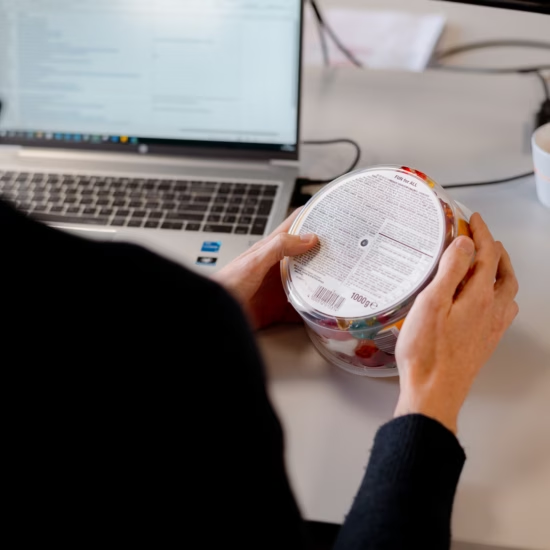
Packaging is usually the first thing consumers see - and therefore the first thing they interpret. Packaging implicitly communicates promises about taste, quality, durability or health. If reality does not match the expectation created by the packaging, there is noise in the brand experience.

This can lead to confusion about what the product actually is, incorrect positioning, loss of recognition when restyling, or simply a failure of purchase intent. So well-designed packaging is not a luxury, but a prerequisite for market success.

At Het Smaakhuis, we therefore evaluate not only the sensory quality of products, but also the effectiveness of packaging. Among other things, we investigate:

  • Does the consumer understand at a glance what the product is?
  • Which packaging evokes the most buying intention?
  • Does the packaging convey the desired quality or brand value?

Risk-based thinking: beyond QA

Sensory research and packaging are traditionally assigned to departments such as R&D, marketing or sales. But they equally deserve a place within risk management. Not in the context of food safety, but in the context of market success, customer perception and brand trust.

By structurally integrating taste and packaging research into the development process, companies can encounter risks of rejection or misunderstanding at an early stage. In addition, it helps to make informed choices in innovation processes and tenders as well as to get departments to align around a common goal.

Strategic and manageable risks

Packaging that consumers do not understand or a taste that does not convince; both can lead to commercial failure, even if the product is technically perfectly fine. Flavor and packaging are strategic but manageable risks. With proper testing, objective analysis and consumer insight, companies can measure, understand and substantiate them. Need help with your product? Our experts will be happy to help.

Need support in the food sector?

Our experts are happy to think with you and help you quickly on your way.

Request a quote

Fill out the form and we will contact you shortly.

Name
In which country would you like the service to be carried out?
Privacy Policy 

Related news articles

A smiling woman walks through the aisles of a supermarket with a shopping cart and looks at a glass jar of sauce while choosing healthy products among the shelves.
22 Jul 2025

Normec Foodcare introduces Full Product Scan

How does your product really perform? With our Full Product Scan you discover not only whether your product meets the technical requirements, but also how the consumer experiences it. Unique to this approach is the combination of laboratory measurements and sensory consumer research. You see not only what deviates, but also whether it affects the appreciation. The Full Product Scan combines laboratory measurements with sensory consumer research. We analyze parameters such as weight, texture, color, composition and moisture content. At the same time we study how consumers evaluate the product in terms of taste, smell, mouth feel and appearance. This unique combination delivers insights that go beyond standard specification checks.


23 Sep 2024

Why Sensory Testing Plays an Indispensable Role in Product Development

In the food industry, there are numerous reasons to launch a product development process. In general, there are three main reasons, which are either necessary or desirable: developing a new product, developing and producing an existing product (such as a private-label product), and modifying and/or optimizing a product.

A woman is checking the label of muesli on a computer.
09 Sep 2025

Breakfast cereals under the microscope: striking differences between claims and consumer perception

How crunchy should muesli be? And how many nuts do consumers actually expect in a portion of breakfast cereal? We investigated four variants of crunchy muesli with nuts: two A brands and two private brands. We did this using the Full Product Scan, a combination of technical product analysis and consumer research. This provides insight into both composition and appreciation. The results? Clear and directly applicable.

Sign up for our newsletter

Sign up

Naam

Related services

Taste & Experience

A laboratory technician holds a petri dish and a cotton swab during a microbiological test.

Product Research

Packaging Research