
Accessibility links Skip to main content

How Consumer Expectations Influence Product Perception

Consumers don’t judge a product only when they taste it. Often, their first impression is already formed before the package is even opened. Claims, brand name, appearance, and past experiences play a major role in shaping what consumers expect from a product.

Contact Us

Fill out the form and we will contact you shortly.

Name
In which country would you like to be assisted?
Privacy Policy 
Continue reading

As a result, the same recipe can be evaluated differently depending on the context in which it is offered. For manufacturers, this means that product development is not only about taste and quality, but also about aligning expectations with the actual product experience.

Consumers taste with more than just their taste buds

When a consumer sees a product on the shelf, expectations are immediately formed. Premium packaging suggests quality, a sustainable design evokes different associations than a traditional one, and a product claim influences what someone expects in terms of taste, texture, and quality.

The final product evaluation stems from a combination of what consumers expect and what they actually experience. When these two do not align, even a high-quality product may be rated less positively.

Why Consumer Expectations Are Becoming Increasingly Important

Consumers receive information through packaging, social media, online reviews, and marketing campaigns. At the same time, brands are increasingly using nutrition claims to position products as unique, such as:

  • High Protein
  • Reduced Sugar
  • Clean Label
  • Plant-Based
  • Less Sugar
  • High in Protein

Such claims can influence purchasing decisions and, at the same time, shape expectations regarding taste, health, and product quality. That is why it is important not only to evaluate the recipe but also to examine what expectations the product’s marketing communications evoke.

How do nutrition claims influence product perception?

A consumer who buys a product with a “high-protein” claim often expects to be making a health-conscious choice. At the same time, expectations may arise regarding texture, mouthfeel, or taste. The same applies to products with less sugar, less fat, or a sustainable positioning.

Consumers can accept changes as long as the overall product experience aligns with their initial expectations. When expectations and actual experience diverge too widely, this can affect:

  • Product evaluation
  • Customer satisfaction
  • Brand trust
  • Repeat purchases

That is why manufacturers look not only at the technical changes in a product but also at the expectations the product evokes.

Expectations and reality must align

A successful product launch isn’t just about having a technically sound product. It’s about striking the right balance between product features, positioning, and consumer expectations.

After all, a consumer doesn’t buy a product based solely on its ingredients or nutritional value. Ultimately, taste, texture, smell, appearance, and the overall product experience determine whether someone will choose the product again. The better expectations and reality align, the greater the likelihood of customer satisfaction and repeat purchases.

How do you research consumer expectations?

Consumer expectations are not reflected in product specifications or laboratory results. Consumer research and sensory testing can be used to investigate how consumers experience products, what expectations they have beforehand, and what factors influence their evaluation.

For example, product claims, packaging, formulations, or product variants can be compared under different conditions. This provides insight not only into what consumers choose but also into the reasons behind those choices.

From First Impression to Repeat Purchase

A first purchase is important, but ultimately, repeat purchases determine a product’s long-term success. That is why manufacturers are increasingly focusing on the entire consumer experience: from expectations before tasting to evaluation after use.

By systematically researching product experience, insights emerge regarding opportunities for product optimization, positioning, and innovation. This helps tailor products more effectively to the target audience’s preferences.

What does this mean for manufacturers?

For manufacturers, the challenge lies in developing products that not only meet technical requirements but also align with consumer expectations. Understanding product perception and consumer expectations helps with:

  • Substantiating product concepts
  • Optimizing packaging and claims
  • Validating formula changes
  • Justifying product launches
  • Encouraging repeat purchases
  • Strengthening the brand experience

This creates a better alignment between what consumers expect and what a product actually delivers.

Curious about how consumers truly experience your product?

Sensory testing and consumer research provide insights into how expectations, packaging, claims, and product characteristics influence how your product is rated.

Frequently Asked Questions

Product experience describes how consumers perceive a product in terms of taste, smell, texture, appearance, and overall satisfaction.

Claims such as “high protein,” “reduced sugar,” and “clean label” can create expectations regarding taste, health, and product quality. These expectations can influence the final product rating.

When expectations do not match the actual product experience, this can affect product ratings, customer satisfaction, and repeat purchases.

Consumer research and sensory testing can be used to investigate how consumers experience products, what expectations they have going in, and which product characteristics influence their evaluation.

Related News Articles

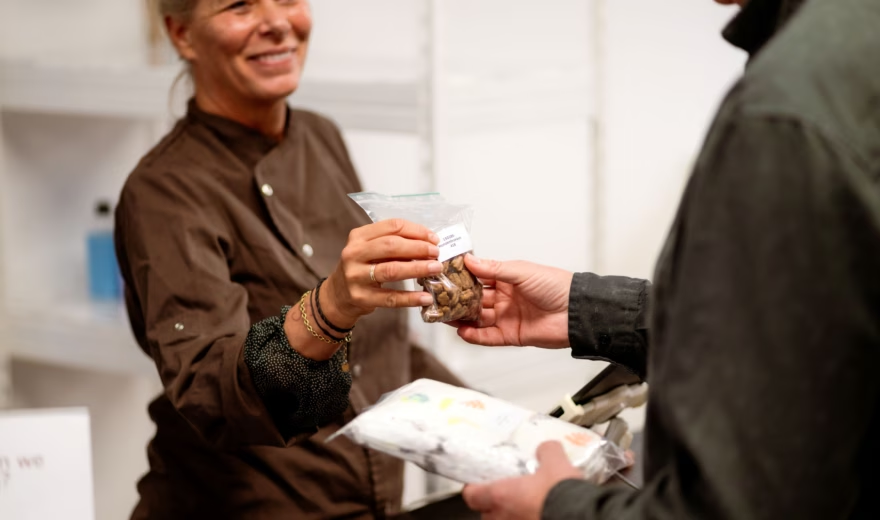
Een persoon overhandigt verpakte monsters aan een andere persoon voor verwerking of beoordeling.
14 Aug 2026

Normec Sensory Opens New Sensory Testing Center in Liège

LIÈGE – Normec Sensory is further expanding its presence in Belgium with the opening of a new sensory testing center in Liège. With this expansion, Normec Sensory now has its own testing infrastructure in both Flanders and Wallonia. This enables organizations to rely on in-depth consumer insights from across Belgium, supported by local expertise and a broad network of respondents.

A smiling woman walks through the aisles of a supermarket with a shopping cart and looks at a glass jar of sauce while choosing healthy products among the shelves.
22 Jul 2025

Normec Foodcare introduces Full Product Scan

How does your product really perform? With our Full Product Scan you discover not only whether your product meets the technical requirements, but also how the consumer experiences it. Unique to this approach is the combination of laboratory measurements and sensory consumer research. You see not only what deviates, but also whether it affects the appreciation. The Full Product Scan combines laboratory measurements with sensory consumer research. We analyze parameters such as weight, texture, color, composition and moisture content. At the same time we study how consumers evaluate the product in terms of taste, smell, mouth feel and appearance. This unique combination delivers insights that go beyond standard specification checks.

23 Sep 2024

Why Sensory Testing Plays an Indispensable Role in Product Development

In the food industry, there are numerous reasons to launch a product development process. In general, there are three main reasons, which are either necessary or desirable: developing a new product, developing and producing an existing product (such as a private-label product), and modifying and/or optimizing a product.

02 Jun 2025

Why Reducing Sugar Only Works If It Tastes Good

On June 2, “A Healthier Week” kicks off—an initiative by the Diabetes League that challenges Flemish residents to make healthier choices for a week, with an emphasis on reducing added sugars. This presents a huge opportunity for food companies: consumers do want to eat healthier, but their choices are still driven by taste. So reducing sugar is more than just a recipe tweak. It’s a flavor challenge. And you can only overcome it with the help of consumers.

Sign up for our newsletter

Sign Up

Naam

Related services

Sensory research

A laboratory technician holds a petri dish and a cotton swab during a microbiological test.

Product Research

Product and Category Development

Taste & Experience

Een medewerker gebruikt een iPad om foto’s te maken van sinaasappels tijdens een kwaliteitscontrole, terwijl hij de producten nauwkeurig onderzoekt.

Zero measurement quality system

Een medewerker gebruikt een iPad om foto’s te maken van sinaasappels tijdens een kwaliteitscontrole, terwijl hij de producten nauwkeurig onderzoekt.

Self-monitoring system Good & Green

Packaging Research