


Accessibility links Skip to main content

New Allergen Policy in the Netherlands: from 14 to 24 allergens?

The NVWA's new allergen policy, effective January 1, 2024, was a shock for many companies. In practice, the new policy requires quite a bit of work. What also doesn't help is that two allergens (gluten-containing grains and nuts) seem to have been split. What exactly is this about?

Contact us

Fill out the form and we will contact you shortly.

Name
In which country would you like to be assisted?
Privacy Policy 
Continue reading

New allergen policy

On Jan. 1, 2026, the new allergen policy must be implemented. Products placed on the market from then on must comply with the new allergen policy in terms of labeling. For many manufacturers, this means that the entire allergen management policy must be scrutinized. Information from raw materials must be requested, cleaning must be validated, calculations must be made and labels must be adjusted. This is not made easier by "splitting" two allergens: gluten-containing grains and nuts.

Why split?

One in five Dutch people have an allergy and 'splitting' these allergens is very important for the allergic consumer. This is because they contain different proteins. Because of this, there are many consumers who are allergic to some but not all nuts. In the Normec Label & Specification department, for example, someone is allergic to hazelnuts and cashews but not to the other six. This means that a pecan pie can be enjoyed despite having nuts in it. Not splitting the group of nuts would make the range of products that cannot be consumed much larger.

Nothing new

However, "splitting" these allergens is not new. Back in 2017, the EU Commission made it clear in a communication that the ingredient list must indicate the specific gluten-containing cereal and nut type. The only thing is that there is now confirmation of this in the cross-contamination as well. Until the introduction of the NVWA's new allergen policy, there was no legal basis for cross-contamination labeling (Precautionary Allergen Labeling or PAL). Now that this is being allowed by the Ministry of Health, Welfare and Sport (VWS) and legal value is being placed on it, cross-contamination therefore requires this split. In essence, we ourselves as an industry have chosen to combine all nuts and grains when cross-contaminated but the VWS now indicates that we do have to do it according to the rules.

Gluten-containing grains

The policy and accompanying published guidelines talk about a reference dose for gluten-containing grains of 5.0 mg with a maximum action limit of 20 mg/kg of gluten protein. This maximum action limit of 20 mg/kg of gluten protein has been added because that is the limit for the claim gluten-free.As a manufacturer, therefore, you must distinguish between these four types of grains in everything (raw material specifications, production planning, cleanup, calculations, and end-product specifications such as labels).

Nuts

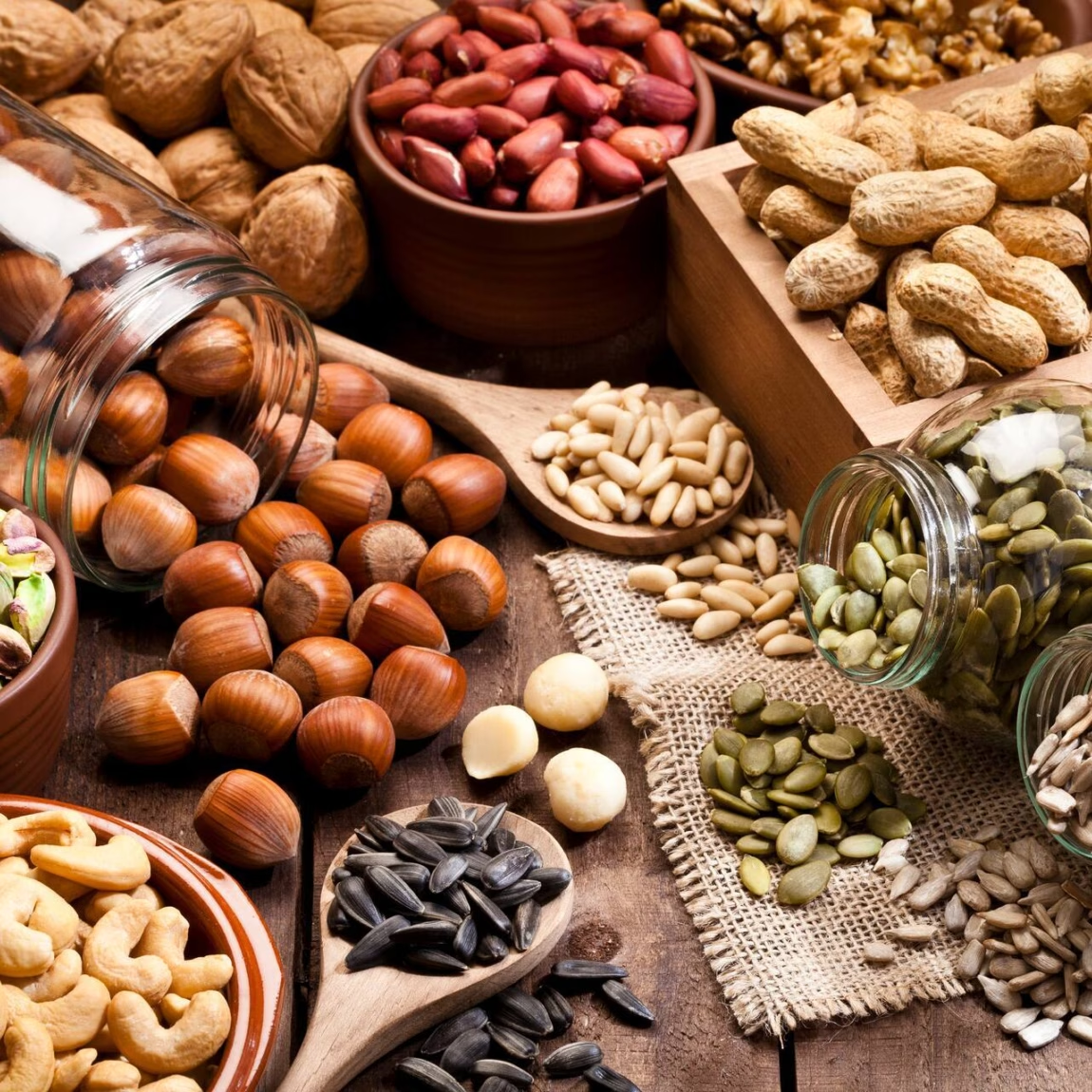
The reference doses given for the various nuts are per species. This means that again, as a producer, you must distinguish between these eight types of nuts in everything (raw material specifications, production planning, cleaning, calculations and end product specifications such as labels). Note that hazelnuts have a different reference dose than most nuts.

Nuts, by species || Reference dose, VWS 2024 (mg allergen protein)

Almond || 1,0

Hazelnut || 3,0

Walnut || 1,0

Cashew nut || 1,0

Pecan || 1,0

Brazil nut || 1,0

Pistachio || 1,0

Macadamia nut || 1,0

Conclusion

There are 14 allergens identified in Annex II of Regulation (EU) No 1169/2011. However, the group gluten-containing grains and nuts contain an exhaustive list of grains and nuts that are part of this and must be designated by specific species. As an industry, we made the choice to aggregate these in the past when feeding a PAL but we are now being knocked back. This means you have to start taking this into account within your company. The only time you may possibly merge them is if the label requires a PAL for all grains or nuts. Then they may be merged in the text. So it is "May contain almonds, hazelnuts, walnuts, cashews, pecans and pistachios." but if it also applies to Brazil nuts and macadamia nuts it may become "May contain nuts."

Prepare properly

Do you have questions about preparing for the new allergen policy or run into something? If so, we will be happy to help. Want to know more about allergen management and how to ensure the safety of your products? Then download our free white paper on allergen management and discover practical tips and insights that you can immediately apply in your business operations. The following topics are covered:

  • Allergen management over time
  • The impact of allergens from a product and process perspective
  • Concrete steps for a successful allergen management system

Need support in the food sector?

Our experts are happy to think with you and help you quickly on your way.

Request a quote

Fill out the form and we will contact you shortly.

Name
In which country would you like the service to be carried out?
Privacy Policy 

Related news articles

25 Jul 2025

Allergen analysis: best practices

More and more people have a food allergy. Think of allergies to milk, nuts, egg or gluten. It is therefore very important for food producers to prevent cross-contamination with allergen-containing substances during production in foods where these allergens do not occur. The article below clarifies which methods are suitable for testing for the presence of allergens. And especially: how to apply them in a smart and practical way.
23 Jun 2026

Cross-contamination and PAL: from assessment to evidence-based decisions

Allergen management and cross-contamination remain among the most sensitive topics in food safety and QA within the food industry. Not only because the impact on consumers can be significant, but also because the rationale behind Precautionary Allergen Labeling (PAL) is often more complex than it appears at first glance.

23 Jan 2025

New Dutch allergen policy included in version 9.0 of NVWA handbook on labeling

As of Jan. 1, 2026, the new Dutch allergen policy must be implemented. This policy will be endorsed in the policy rule Warenwet allergen labeling out of precaution. This is currently not yet published, but will correspond to the policy document that has already been published. What does this now mean in practice for food companies?

19 Nov 2025

NVWA Q&A Allergens: Time to really get your QA policies in order

The Netherlands Food and Consumer Product Safety Authority (NVWA) recently published an important Q&A on allergen policy in the food industry. This publication is not just an update; it provides concrete guidance on how to set up your processes, labeling and risk assessment to comply with the new regulations, which must be in full force by Jan. 1, 2026. For QA managers, this means that procrastination is not an option: now is the time to take a critical look at your allergen policies.

Sign up for our newsletter

Sign up

Naam

Related services

Drafting label text

Label review

Allergen Management

Allergen analysis and allergen management