
Get a handle on microbiological safety and shelf life
How do microorganisms behave during your product’s shelf life? Can Listeria monocytogenes grow? And what changes when you adjust the recipe, packaging, or storage conditions?
Challenge testing allows you to investigate how relevant microorganisms behave in your specific product. Under controlled conditions, the test determines whether a microorganism can grow, survive, or die. This provides you with concrete information to better support decisions regarding product safety, shelf life, and product development.
Challenge testing has a broader range of applications than just Listeria monocytogenes. Depending on your product and research questions, testing can focus, for example, on Salmonella, Bacillus cereus, yeasts, or molds.
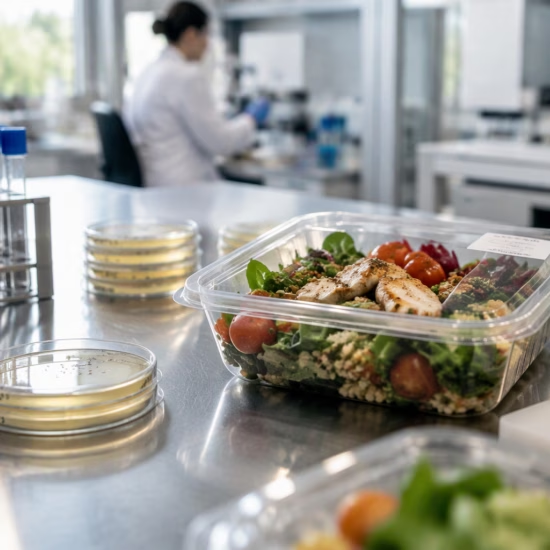
When is challenge testing relevant?
Every food product has its own characteristics. Factors such as pH, water activity, formulation, preservatives, packaging, and storage conditions can influence the behavior of microorganisms.
Challenge testing may be relevant when you:
- want to substantiate a product’s microbiological safety;
- want to gain insight into the behavior of microorganisms during the shelf life;
- are developing a new product;
- are evaluating or wish to change an existing shelf life;
- are modifying a formulation;
- are going to use different packaging;
- are changing storage or distribution conditions;
- want to know if a preservation strategy is effective enough;
- have a specific issue regarding Listeria monocytogenes in a ready-to-eat product.
The starting point is always the same: what do you want to know about the microbiological behavior of your product?
What is a challenge test?
In a challenge test—also known as a provocation test—a known number of selected microorganisms are intentionally added to a food product.
The product is then stored under specified storage conditions, such as time, temperature, and packaging. During the test, researchers monitor whether the selected microorganism grows, survives, or dies.
This provides insight into the microbiological behavior within the specific product matrix.
This is important because two products that appear similar at first glance may react differently from a microbiological perspective. Factors such as pH, water activity, packaging, and product composition can all influence microbial growth.
Challenge testing can address a variety of issues. Therefore, the testing does not have to be relevant only when a microbiological problem already exists.
From Shelf Life to Product Development
-
1.
Justify the shelf life
Would you like to know what happens microbiologically during a product’s intended shelf life? Challenge testing provides insight into how a selected microorganism behaves under specified conditions.
This can be relevant, for example, when you’re reassessing an existing shelf life or investigating the possibility of a longer shelf life.
-
2.
Developing a New Product
With a new food product, the formulation, product characteristics, and packaging can create new microbiological conditions.
By incorporating challenge testing into the product development process, you gain targeted information that can be factored into decisions regarding safety and shelf life.
-
3.
Change the formula or packaging
A new formulation, different packaging, or altered storage conditions can affect the microbiological behavior of a food product.
Preservation strategies such as salt, acid, MAP packaging, or heat treatment can also be evaluated through challenge testing to determine their effect on a specific product.
Challenge testing is more than just Listeria
Challenge testing is often associated with Listeria monocytogenes. However, its application is broader.
Depending on your product, risk, and research question, challenge testing can, for example, be performed with:
- Listeria monocytogenes
- Salmonella
- Bacillus cereus
- yeasts
- molds
Which microorganisms are relevant depends, among other things, on the product composition, the production process, the conditions under which the product is stored, and the question you want to answer with the study.
That’s why a good challenge test doesn’t start with selecting a standard assay, but with your product and research question.
Listeria Challenge Testing for Ready-to-Eat Products
Listeria monocytogenes warrants special attention in ready-to-eat foods.
A Listeria challenge test simulates contamination under controlled conditions to determine whether and to what extent Listeria monocytogenes can grow during the shelf life. The results can provide insight into, among other things, potential growth during storage, the effectiveness of control measures, and support for regulatory compliance and audits.
A challenge test can be part of a broader Listeria study. Factors such as raw materials, the production process, hygiene measures, storage, composition, and growth-inhibiting components may be relevant in this context.
Challenge testing or shelf-life testing?
Challenge testing and standard shelf-life testing do not address exactly the same question.
In shelf-life testing, you monitor how a product behaves over its shelf life.
In challenge testing, a selected microorganism is intentionally added to the product. You then specifically investigate how this organism behaves under the chosen conditions.
Which approach is most suitable therefore depends on what you want to know about your product. Not sure yet which test you need? Our specialists will work with you to assess the product and the research question.
How is a challenge test conducted?
-
1.
We'll assess your question
We start with the product and the decision you want to be able to make based on the research. In doing so, we look at factors such as product composition, intended shelf life, packaging, and storage conditions.
-
2.
We determine an appropriate research design
Next, we determine which microorganisms, conditions, and sampling times are relevant. This is an important step. Factors such as product composition, pH, water activity, temperature, and packaging can influence microbiological behavior.
-
3.
We're conducting the challenge test
The selected microorganism is added to the product under controlled conditions. The product is then stored and examined according to the specified conditions.
-
4.
We monitor the microbiological behavior
At relevant intervals, measurements are taken to track the microorganism’s development. This reveals whether the organism is growing, surviving, or declining during the study period.
-
5.
You'll gain insight into the results
The results provide you with information you can use to support decisions regarding product safety, shelf life, or product development.
Which type of research is right for your product?
Do you have a new product, a shelf-life issue, an RTE product, or are you changing the recipe, packaging, or storage conditions? Submit your product and question to our specialists.
Frequently Asked Questions About Challenge Testing
-
Bij challenge testing wordt een geselecteerd micro-organisme bewust aan een voedingsmiddel toegevoegd. Vervolgens wordt onder vastgestelde omstandigheden onderzocht of het micro-organisme groeit, overleeft of afneemt.
-
Challenge testing geeft inzicht in het microbiologische gedrag van een organisme in een specifiek product. De resultaten kunnen worden gebruikt bij vraagstukken rondom productveiligheid, houdbaarheid en productontwikkeling.
-
Nee. Naast Listeria monocytogenes kan challenge testing bijvoorbeeld worden toegepast op Salmonella, Bacillus cereus, gisten en schimmels. Welk organisme relevant is, hangt af van het product en de onderzoeksvraag.
-
Bijvoorbeeld bij de ontwikkeling van een nieuw product, een houdbaarheidsvraagstuk, een Ready-to-Eat product of een verandering in receptuur, verpakking of bewaarcondities.
-
Bij challenge testing wordt doelbewust een geselecteerd micro-organisme aan een product toegevoegd om het gedrag daarvan te onderzoeken. Bij regulier houdbaarheidsonderzoek wordt de ontwikkeling van het product gedurende de bewaartermijn gevolgd.
-
Ja. Met een Listeria challenge test kan onder gecontroleerde omstandigheden worden onderzocht of en in welke mate Listeria monocytogenes gedurende de houdbaarheid in een product kan groeien.
-
Dat is afhankelijk van het product en de onderzoeksvraag. Denk onder andere aan productsamenstelling, pH, wateractiviteit, verpakking, temperatuur, bewaartijd, de geselecteerde micro-organismen en relevante meetmomenten.
-
Dat hoef je niet vooraf zelf te bepalen. Bespreek het product, de omstandigheden en de vraag die je wilt beantwoorden. Op basis daarvan kan worden beoordeeld welke onderzoeksaanpak het beste aansluit.