Accessibility links Skip to main content

Amendment to the Nickel Act

Effective July 1, 2025, new European legislation will take effect that imposes stricter regulations on the presence of nickel in food. This step is part of a broader approach by the European Union to limit exposure to heavy metals through food and thereby protect public health.

Contact us

Fill out the form and we will contact you shortly.

Name
In which country would you like to be assisted?
Privacy Policy 
Continue reading

What Is Nickel?

Nickel is a naturally occurring metal in the soil, but it also comes from industrial sources such as fertilizers, irrigation water, atmospheric deposition, or packaging materials. Crops absorb nickel from the soil, and in some areas—for example, near industrial sites or in heavily fertilized agricultural land—nickel levels may be elevated.

Although nickel poses no immediate danger in small amounts, it is a risk factor for sensitive individuals, such as people with a nickel allergy or nickel-sensitive eczema. That is why the EU is tightening the standards.

What does the legislation entail?

Effective July 1, 2025:

  • Maximum residue limits (MRLs).
  • Mandatory analyses of nickel levels.
  • Stricter rules for imports from third countries, where the risk of exceeding limits is higher.
  • Monitoring and reporting requirements for national regulatory authorities such as the NVWA.

The exact limits vary by product category and are based on European risk assessments (EFSA).

To which products does this apply?

The new limits apply, among other things, to:

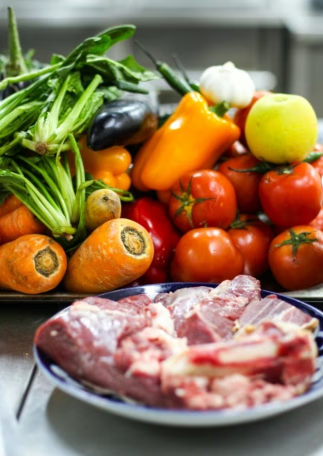
  • Fruits and vegetables (potatoes, vegetables, and fruits)
  • Grains and grain products
  • Nuts and seeds
  • Cocoa and chocolate products
  • Seaweed and algae-based products
  • Baby and toddler food
  • Fruit juices and plant-based beverages

If you’re active in the produce and food industries, it’s essential to prepare for these regulations

What does this mean for you?

  1. 1.

    Analysis

    Have products tested for nickel content in a timely manner.

  2. 2.

    Documentation

    Ensure proper documentation of growing conditions and origin.

  3. 3.

    Collaboration

    Collaborate with laboratories, such as Normec Groen Agro Control, that are accredited for trace element analyses.

  4. 4.

    Inform and Adjust

    Inform your supply chain partners and adjust contract terms as necessary.

Nickel Sensitivity and Consumer Safety

For consumers, this law provides an additional safeguard for food safety. In particular, people with a nickel allergy or hypersensitivity will receive better protection through food, a source of nickel that has been overlooked until now.

Need support in the food sector?

Our experts are happy to brainstorm with you and get you started quickly.

Request a quote

Fill out the form and we will contact you shortly.

Name
In which country would you like the service to be carried out?
Privacy Policy 

Related news articles

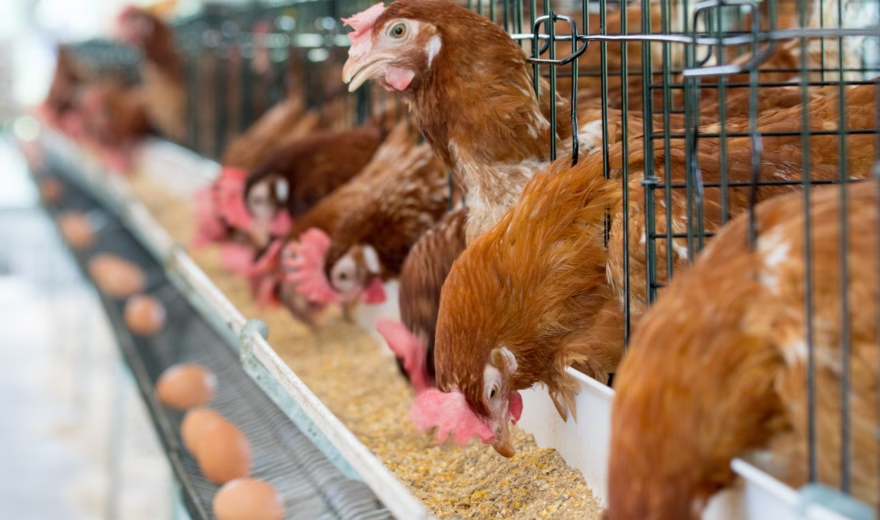
Laying hens are kept in a poultry house where eggs are produced and collected.
25 Aug 2026

Salmonella in eggs: recent outbreak highlights the importance of targeted testing

A Salmonella outbreak linked to eggs from a Belgian poultry farm has now made at least 300 people ill. The incident once again shows the importance of systematic monitoring and timely laboratory testing throughout the egg supply chain.
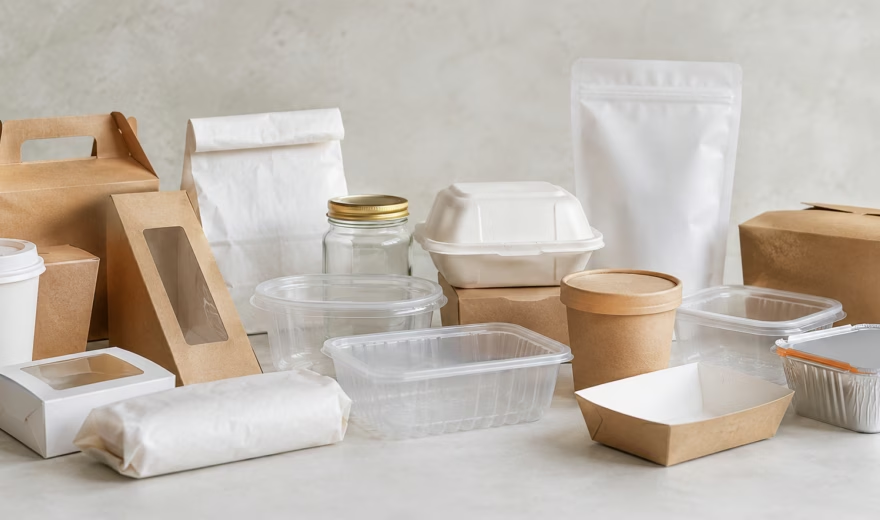
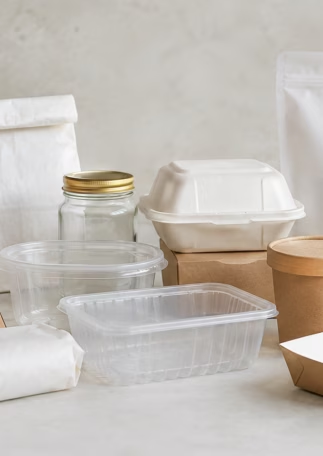
Various food packaging materials, suitable for quality and sustainability testing.
12 Aug 2026

The PPWR now applies: what does this mean for your packaging?

The European Packaging and Packaging Waste Regulation (PPWR) has applied since 12 August 2026. This marks the start of an important new phase for every organisation that manufactures, imports, uses or places packaging on the European market. The Regulation introduces stricter requirements covering substances of concern, recyclability, material use, reuse and the evidence needed to demonstrate compliance. For food businesses, this is no longer a distant development. The first obligations already apply, with further requirements being introduced in phases over the coming years. It is therefore essential to understand your packaging portfolio and determine in good time where changes are needed.

A liquid sample is added to a petri dish with a pipette for laboratory analysis.
27 Jul 2026

Normec Informs Customers About Regulations Regarding Animal By-Products When Submitting Samples

WIERINGERWERF – Normec Foodcare is reminding customers of the applicable European regulations for animal by-products (ABP) and derived products. This is in response to increased scrutiny by the Netherlands Food and Consumer Product Safety Authority (NVWA) regarding the correct application of this legislation within the chain of sample submission, analysis, and processing. The regulations are set forth in Regulation (EC) No. 1069/2009 and the accompanying implementing provisions in Regulation (EU) No. 142/2011. The purpose of these regulations is to protect public health, animal health, and the safety of the food and feed chains.

An analog temperature gauge displays the temperature of a system or process environment.
23 Jun 2026

Summer Stress in the Agri-Food Industry: What Are the Main Risks to Food Safety?

For many companies in the food industry, summer is a challenging time. Vacation periods lead to staff turnover, supply chains are put to the test, and rising temperatures increase the risk of deviations in production, storage, and distribution. At the same time, consumer behavior is changing: products are consumed out of the home more often, remain out of refrigeration for longer periods, and are stored differently than originally planned.

Employees perform visual inspections of food products in a production environment.
23 Jun 2026

Why You Can’t Blindly Trust Supplier Declarations

Supplier declarations remain indispensable, but they are essentially dependent on information provided further down the supply chain. Every link in that chain introduces variation, and changes in raw materials, processes, or suppliers can have an impact without this being immediately apparent in the documentation that is ultimately passed on.

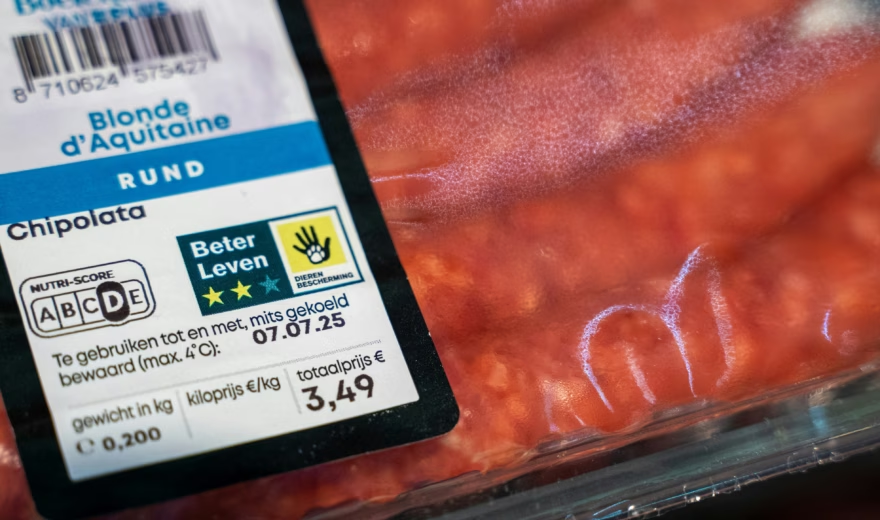
Close-up photo of packaged beef chipolata with product information and nutrition label.
23 Jun 2026

Errors in Label Verification: Where the Risk Lies

In the food industry, label verification is much more than a final administrative step in the quality process. It is a critical control measure within food safety and QA, with a direct impact on consumer safety, compliance, and the risk of recalls. Yet in practice, it turns out that label checking and verification remain a structural weak point within many organizations.

23 Jun 2026

Cross-contamination and PAL: from assessment to evidence-based decisions

Allergen management and cross-contamination remain among the most sensitive topics in food safety and QA within the food industry. Not only because the impact on consumers can be significant, but also because the rationale behind Precautionary Allergen Labeling (PAL) is often more complex than it appears at first glance.

Sign up for our newsletter

Sign up

Naam

Related services

Een vrouwelijke onderzoeker met veiligheidsbril, blauwe handschoenen en witte labjas werkt geconcentreerd in het lab en pipetteert vloeistof in een reageerbuis.

Contaminants and residues analysis

Food safety risk scan