
Accessibility links Skip to main content

How do you know if consumers accept your sugar reduction or protein fortification?

A product can be technically successful but still fail commercially. Less sugar, more protein, a clean label, or a new texture can affect taste, mouthfeel, and consumer expectations. Sensory consumer research reveals how consumers experience these changes, what differences they perceive, and which variant best aligns with their preferences and purchase intent.

Contact us

Fill out the form and we will contact you shortly.

Name
In which country would you like to be assisted?
Privacy Policy 
Continue reading
Employees are discussing matters at a service desk in a modern office environment.

Technically successful innovation, but what do consumers think of it?

Consumers are looking for healthier, protein-rich, and more sustainable products, but they still base their choices primarily on taste and sensory experience. That makes reformulation complex. Sugar, for example, affects more than just sweetness; it can also alter texture, mouthfeel, and body. Added protein can be nutritionally beneficial, but it can sometimes result in a drier texture or an unusual aftertaste. A similar risk applies to fat reduction, clean label initiatives, and other formulation adjustments.

Consequently, the question is not only whether a product is technically feasible, but also whether consumers will appreciate the new product and continue to buy it. Sensory consumer research reveals how consumers perceive taste, texture, and the overall product experience. These insights help manufacturers validate recipe changes and better align products with consumer expectations before they hit the market.

When consumer preferences are incorporated too late—or not at all—into the development process, there is a risk that a technically successful reformulation or innovation will fail to meet consumer expectations. This can lead to costly adjustments at a late stage or even to a product that underperforms after launch. By involving consumers early in the NPD cycle, you can make timely adjustments and informed decisions. This increases the likelihood of a successful market launch.

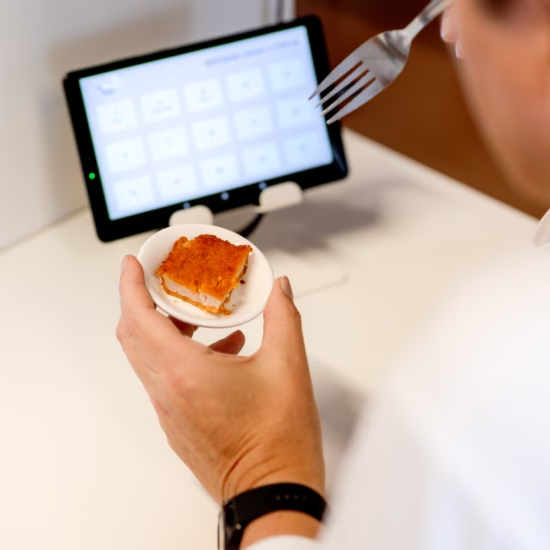
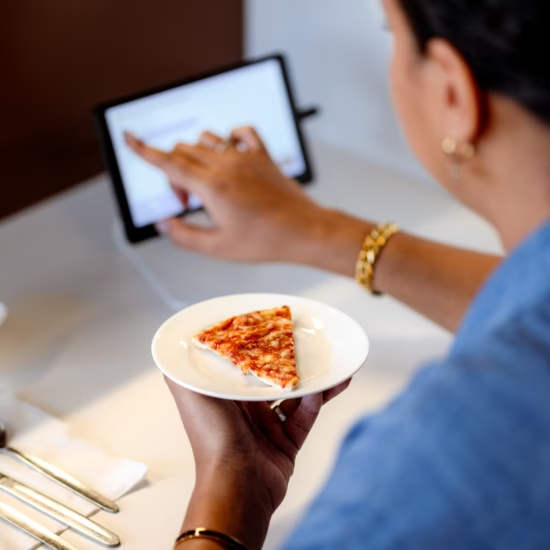
Evaluation of a food product using a digital questionnaire.

When should you use consumer research?

Many companies only use sensory consumer research at the time of a product launch. It is precisely when this research is applied earlier in the development process that it yields the most insights and added value. Consider selecting prototypes, comparing reformulation variants, benchmarking against competitors, or determining why a particular variant scores better.

Claims such as “high protein,” “reduced sugar,” or “clean label” also influence expectations. An interesting research question in this context is whether consumers evaluate the exact same product differently when they know it contains less sugar or more protein.

Consumer research helps shed light on that impact and better inform development decisions.

The participant evaluates a food product using a digital evaluation screen.

How can Normec Sensory help you with this?

Normec Sensory supports food manufacturers with consumer research throughout the entire product development cycle. This provides you with insights into which product characteristics consumers value, how different product variants are evaluated, and which recipe adjustments align with consumer expectations.

The results provide valuable input for product development, validation, and market launch.

Curious about the opportunities and preferences we can identify within your product range?

Contact our specialists in sensory and consumer research.

Request a quote

Fill out the form and we will contact you shortly.

Name
In which country would you like the service to be carried out?
Privacy Policy 

Related news articles

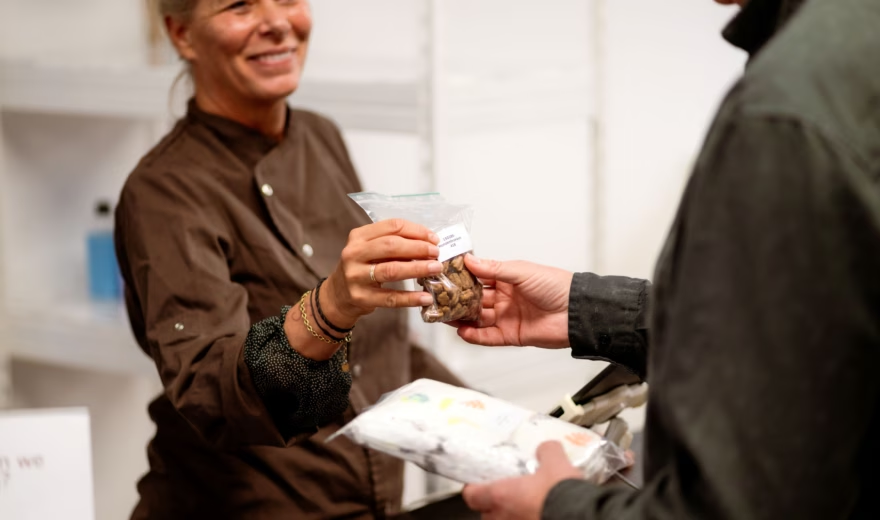
Een persoon overhandigt verpakte monsters aan een andere persoon voor verwerking of beoordeling.
14 Aug 2026

Normec Sensory Opens New Sensory Testing Center in Liège

LIÈGE – Normec Sensory is further expanding its presence in Belgium with the opening of a new sensory testing center in Liège. With this expansion, Normec Sensory now has its own testing infrastructure in both Flanders and Wallonia. This enables organizations to rely on in-depth consumer insights from across Belgium, supported by local expertise and a broad network of respondents.

A smiling woman walks through the aisles of a supermarket with a shopping cart and looks at a glass jar of sauce while choosing healthy products among the shelves.
22 Jul 2025

Normec Foodcare introduces Full Product Scan

How does your product really perform? With our Full Product Scan you discover not only whether your product meets the technical requirements, but also how the consumer experiences it. Unique to this approach is the combination of laboratory measurements and sensory consumer research. You see not only what deviates, but also whether it affects the appreciation. The Full Product Scan combines laboratory measurements with sensory consumer research. We analyze parameters such as weight, texture, color, composition and moisture content. At the same time we study how consumers evaluate the product in terms of taste, smell, mouth feel and appearance. This unique combination delivers insights that go beyond standard specification checks.

23 Sep 2024

Why Sensory Testing Plays an Indispensable Role in Product Development

In the food industry, there are numerous reasons to launch a product development process. In general, there are three main reasons, which are either necessary or desirable: developing a new product, developing and producing an existing product (such as a private-label product), and modifying and/or optimizing a product.

02 Jun 2025

Why Reducing Sugar Only Works If It Tastes Good

On June 2, “A Healthier Week” kicks off—an initiative by the Diabetes League that challenges Flemish residents to make healthier choices for a week, with an emphasis on reducing added sugars. This presents a huge opportunity for food companies: consumers do want to eat healthier, but their choices are still driven by taste. So reducing sugar is more than just a recipe tweak. It’s a flavor challenge. And you can only overcome it with the help of consumers.

Sign up for our newsletter

Sign up

Naam

Related services

A laboratory technician holds a petri dish and a cotton swab during a microbiological test.

Product Research

Product and Category Development

Taste & Experience