


Accessibility links Skip to main content

New MRLs for difenoconazole effective May 2027

UTRECHT – The European Commission has established new maximum residue limits (MRLs) for difenoconazole in and on a wide range of food products. The changes will take effect on May 5, 2027. It is particularly important for companies that grow, import, process, or trade potatoes, vegetables, fruits, nuts, and other plant-based products to implement the new limits in the supply chain in a timely manner.

Continue reading

What’s going on?

With Commission Regulation (EU) 2026/2299, the European Commission is amending the maximum residue limits for difenoconazole in the annexes to Regulation (EC) No. 396/2005. The amendment affects many fresh and processed plant products, animal products, and herbs and spices.

For potatoes, sweet potatoes, eggplants, Swiss chard, cardoons, and celery, the MRLs are being lowered. As a result, residue levels that are still compliant under the current rules may exceed the legal limit as of May 5, 2027.

Key Changes for Fruits and Vegetables

Product New MRL Practical Implications
Potatoes and sweet potatoes 0.07 mg/kg MRL is being reduced
Eggplants 0.5 mg/kg MRL is being reduced
Swiss chard 3 mg/kg MRL is reduced
Celery 5 mg/kg MRL is reduced
Citrus fruits 0.6 mg/kg Explicit EU review level
Nuts 0.03 mg/kg Explicit EU reference level
Mango 0.2 mg/kg Explicit EU reference level
Dried peas and soybeans 0.15 mg/kg Explicit EU screening level

Change also applies to animal products

For most animal products, the residue definition for testing is changing. From now on, difenoconazole alcohol (CGA205375), expressed as difenoconazole, must also be included. For laboratories and companies that test animal products, therefore, not only is the numerical MRL relevant, but also which components are included in the assessment.

Impact on the food sector

The new values apply to growers, importers, trading companies, processors, and retailers. For products where the MRL is decreasing, a test result that currently complies with the law may be assessed differently starting May 5, 2027. Quality managers must therefore review product specifications, risk analyses, supplier agreements, and monitoring programs in light of the new values in a timely manner.

This date is also important for harvest planning, shipping, and inventory management. The transitional arrangement applies to products placed on the market in the European Union before May 5, 2027. Ensuring proper traceability from that point forward helps substantiate compliance with the applicable regulations.

What does this mean for organizations?

  • Identify which products and raw materials in your product range fall under the revised product list.
  • Have growers and suppliers assess whether the use of difenoconazole and the applied waiting periods still align with the future MRLs, especially where the limit is being lowered.
  • Incorporate the new limit values into product specifications and supplier agreements, and check individually whether customers apply stricter internal limits.
  • Re-evaluate existing analysis results against the values that will apply starting May 5, 2027.
  • Verify, for inventory and trade flows, when a product was placed on the market in the EU.

How can laboratory testing help?

Residue analyses can provide insight into whether products comply with the future MRLs. Especially for products for which the limit is being lowered, it can be useful to compare historical results, supplier data, and new measurements against the future regulatory limit.

A thorough assessment requires the right combination of product category, residue definition, analytical method, and applicable MRL. For animal products, the revised residue definition warrants special attention. Therefore, discuss in advance which matrix, substance, and regulatory or additional customer requirements will be central to the assessment.

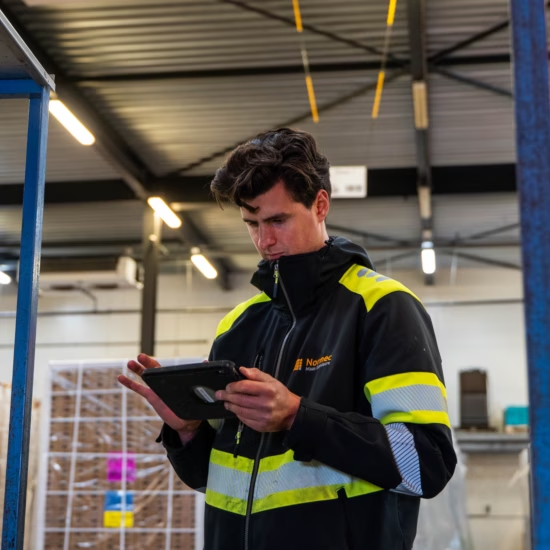
An employee wearing safety gear checks logistics processes in a warehouse using a tablet.

Related in-depth information: MRL and internal limits

An MRL is a statutory maximum limit for a pesticide residue. Retailers and other customers may also apply additional specifications. An analysis result below the statutory MRL therefore does not automatically mean that the product meets all customer requirements. Define statutory compliance and customer requirements that exceed statutory limits separately in specifications and assessment criteria.

Conclusion

Commission Regulation (EU) 2026/2299 introduces new MRLs for difenoconazole for a wide range of food products, effective May 5, 2027. For produce companies, products with a reduced MRL deserve particular attention. By updating specifications, supplier agreements, traceability, and residue monitoring before the effective date, organizations can reduce the risk of exceeding legal limits and failing to meet customer requirements.

Ready for the next step?

Discover how Normec Foodcare helps your organization strengthen quality, food safety, and compliance throughout the supply chain.

Contact Us

Fill out the form and we will contact you shortly.

Name
In which country would you like to be assisted?
Privacy Policy 

Ready to get started with PPWR and your packaging?

Would you like to know what PPWR means for your packaging portfolio and what next steps are relevant for your organization?

Related news articles

Een persoon overhandigt verpakte monsters aan een andere persoon voor verwerking of beoordeling.
14 Aug 2026

Normec Sensory Opens New Sensory Testing Center in Liège

LIÈGE – Normec Sensory is further expanding its presence in Belgium with the opening of a new sensory testing center in Liège. With this expansion, Normec Sensory now has its own testing infrastructure in both Flanders and Wallonia. This enables organizations to rely on in-depth consumer insights from across Belgium, supported by local expertise and a broad network of respondents.

A smiling woman walks through the aisles of a supermarket with a shopping cart and looks at a glass jar of sauce while choosing healthy products among the shelves.
22 Jul 2025

Normec Foodcare introduces Full Product Scan

How does your product really perform? With our Full Product Scan you discover not only whether your product meets the technical requirements, but also how the consumer experiences it. Unique to this approach is the combination of laboratory measurements and sensory consumer research. You see not only what deviates, but also whether it affects the appreciation. The Full Product Scan combines laboratory measurements with sensory consumer research. We analyze parameters such as weight, texture, color, composition and moisture content. At the same time we study how consumers evaluate the product in terms of taste, smell, mouth feel and appearance. This unique combination delivers insights that go beyond standard specification checks.

Employees work on computers in a modern office environment featuring open workspaces and quiet zones.
23 Sep 2024

Why Sensory Testing Plays an Indispensable Role in Product Development

In the food industry, there are numerous reasons to launch a product development process. In general, there are three main reasons, which are either necessary or desirable: developing a new product, developing and producing an existing product (such as a private-label product), and modifying and/or optimizing a product.

02 Jun 2025

Why Reducing Sugar Only Works If It Tastes Good

On June 2, “A Healthier Week” kicks off—an initiative by the Diabetes League that challenges Flemish residents to make healthier choices for a week, with an emphasis on reducing added sugars. This presents a huge opportunity for food companies: consumers do want to eat healthier, but their choices are still driven by taste. So reducing sugar is more than just a recipe tweak. It’s a flavor challenge. And you can only overcome it with the help of consumers.

Sign up for our newsletter

Sign Up

Naam

Related services

Sensory research

Visitors check in at a reception desk while a staff member verifies their information on a tablet.

Product Research

Product and Category Development

Taste & Experience

Een medewerker gebruikt een iPad om foto’s te maken van sinaasappels tijdens een kwaliteitscontrole, terwijl hij de producten nauwkeurig onderzoekt.

Zero measurement quality system

Een medewerker gebruikt een iPad om foto’s te maken van sinaasappels tijdens een kwaliteitscontrole, terwijl hij de producten nauwkeurig onderzoekt.

Self-monitoring system Good & Green

An employee works on product packaging at a computer workstation with multiple monitors.

Packaging Research