Accessibility links Skip to main content

Recalls in Belgium, the Netherlands, France and Germany: trends and lessons learned

Recalls remain an important indicator of how robust food safety systems actually function. European authorities such as the FASFC in Belgium, the NVWA in the Netherlands and the corresponding regulators in France and Germany register recalls piece by piece, while the RASFF platform aggregates these signals on a European level. This creates a rich picture of where processes are vulnerable and where companies can still make gains in prevention and quality control. If you compare the recent figures from Belgium, the Netherlands, Germany and France, you see clear similarities in risk categories, but also clear differences in transparency, reporting culture and process errors. It is precisely these insights that help QA professionals sharpen their own systems.

Contact us

Fill out the form and we will contact you shortly.

Name
In which country would you like to be assisted?
Privacy Policy 
Continue reading

Allergens and labeling remain a major cause in Benelux

In the Netherlands, allergens and related labeling issues are by far the main cause of product recalls and reports. Almost half of Dutch reports are related to allergens. The most common incidents are unreported allergens on the label, followed by errors such as a wrong label or the wrong product in the packaging. Together, these incidents indicate that many risks arise in the last links of the production process, where labeling, product changes and packaging lines come together.

Also in Belgium, unreported allergens are the largest individual cause of reports. However, when other allergen-related incidents are included, such as mislabeling or incorrectly packaged products, the risk distribution appears to be wider than in the Netherlands. In Belgium, chemical contaminations, microbiological risks and physical contaminations are also important categories in the recall picture. This indicates that food safety incidents there are less concentrated around one type of risk.

For QA professionals, this means that allergen management is not just a matter of recipe management, but more importantly of process control on the production floor. Especially in environments with many product variations or private label production, the complexity increases. Processes around labeling, line cleaning, product changes and line release play a crucial role in this. A robust verification system, supported by digital checks or double verification moments, can help prevent errors.

Germany and France: similar risks, totally different reporting level

Comparing Belgium and Germany, it is striking that the distribution of causes is quite similar. In both countries, chemical hazards take a significant share of notifications, followed by allergens, microbiological contaminants and physical contaminants. Residues of pesticides, other chemical contaminants, pathogens and foreign objects are among the most important categories in the German reports.

A striking difference, however, is in the total number of reports. Despite the much larger size of the German food industry, the number of recorded incidents there is lower than in Belgium. This suggests that differences in reporting, publication practices or classification of reports may play a role in the visible figures.

France is a clear outlier. The number of public reports there is many times higher than in the other countries. In addition, the risk profile also differs: microbiological contaminations dominate strongly, with Listeria and Salmonella as the main causes of recalls.

An important explanation for this lies in the French notification system. Since the introduction of the central consumer platform RappelConso, almost all recalls are systematically published publicly. This platform bundles reports from various regulators and makes them directly accessible to consumers. This makes incidents much more visible and reports are often recorded in greater detail than in other countries. Consequently, the high number of French recalls largely reflects a high degree of transparency in reporting.

Chemical and microbiological contaminations: structural risks

In addition to allergens and labeling errors, chemical and microbiological contaminations also play an important role in product recalls in Europe. Reports from national authorities such as the FASFC, the NVWA and through the European Rapid Alert System for Food and Feed show that these risks are often related to raw materials, hygiene in the production process or contaminations in the chain.

Chemical risks usually arise from residues, migration from packaging materials or contaminants that enter the product during cultivation or processing. The most common causes in recalls are:

  • Pesticide residues exceeding legal limits, often in vegetables, fruits or herbs
  • Mycotoxins such as aflatoxin or ochratoxin, mainly in nuts, grains and spices
  • Process contaminants such as acrylamide or mineral oils (MOSH/MOAH)
  • Detergent or disinfectant residues due to insufficient rinsing of equipment
  • Migration of substances from packaging materials, e.g. plasticizers or inks

Microbiological contaminations also remain an important cause of recalls, especially for products with a short shelf life or limited heat treatment. The most commonly reported pathogens are:

  • Salmonella spp., often linked to poultry products, eggs, spices or sesame products
  • Listeria monocytogenes, especially in ready-to-eat products, smoked fish and processed meats
  • Escherichia coli (STEC), mostly associated with raw products or inadequately heated foods
  • Bacillus cereus, especially in rice and cereal products
  • Norovirus or hepatitis A, mainly linked to frozen fruits or shellfish

What can QA professionals learn from this?

The analysis of recalls in Belgium, the Netherlands, France and Germany shows that food safety is increasingly a matter of integral risk management. It is not only about identifying hazards, but especially about controlling complex processes within production and supply chain. Indeed, many incidents occur at moments where processes converge: product changes, labeling, packaging or logistics. These are typical points where human error or insufficient process control can lead to deviations.

For allergen management, this means that companies must look beyond just recipe control. Processes around labeling, line cleaning and product changes deserve at least as much attention. Digital verification systems, clear line clearance procedures and structured allergen risk analyses can help prevent errors.

At the same time, figures from several countries show that QA systems must also be robust in the face of microbiological and chemical risks. Transparency around recalls is also increasing: national authorities are increasingly publishing consumer warnings and product information, making incidents more quickly visible to both consumers and the industry. A strong supplier assessment, raw material control and a well-functioning HACCP system therefore remain essential to comprehensively manage risks.

From reactive to preventive: the real value of recall data

Recalls will never disappear completely, but they offer valuable insights. For QA professionals, they are a mirror of where processes are still vulnerable. By actively analyzing these trends and translating them into improvement actions, companies can evolve from a reactive approach to a more preventive strategy.

This is precisely where the greatest opportunity lies today: seeing recalls not only as incidents, but as data that help to structurally strengthen food safety.

Recalls and notifications in 2025

Total number of notifications/recalls

FranceBelgiumGermanyNetherlands
2.262355160122

Distribution of causes (%)

CauseFranceBelgiumGermanyNetherlands
Microbiological53,7%22,3%17,5%18%
Chemical17,1%26,8%33,8%6,6%
Allergens6,9%22,8%20%45,9%
Physical6,1%13,2%16,9%21,3%
Legislative / compliance4,6%2%0,6%0,8%
Other7,8%13%11,3%7,4%
Damage3,8%---

Most common by country (numbers)

FranceBelgiumGermanyNetherlands

Listeria

Salmonella

Other notifications

Undeclared allergens

Foreign bodies

STEC

Prohibited substances

Excess pesticides

Other chemical contaminations

Manufacturing defects

Undeclared allergens

Listeria

Salmonella

Toxins

Incorrect instruction on label

MOH (mineral oils)

Metal

Crop protection residues

Glass

Allergens

Residues and contaminants

Pathogens

Foreign bodies

Harmful substances

Deception and fraud

Undeclared allergens

Incorrect label

Metal

Listeria

Wrong product in packaging

Glass

Plastic

Production error

STEC

Need support in the food sector?

Our experts are happy to think with you and help you get started quickly.

Request a quote

Fill out the form and we will contact you shortly.

Name
In which country would you like the service to be carried out?
Privacy Policy 

Related news articles

23 Jun 2026

Microbiological Trends in Recalls: What Can We Learn from Recent Incidents?

Microbiological food safety remains one of the leading causes of recalls in the European food industry. Despite stricter controls, improved process control, and comprehensive HACCP systems, recent incidents show that microbiological risks still pose a real and evolving challenge.

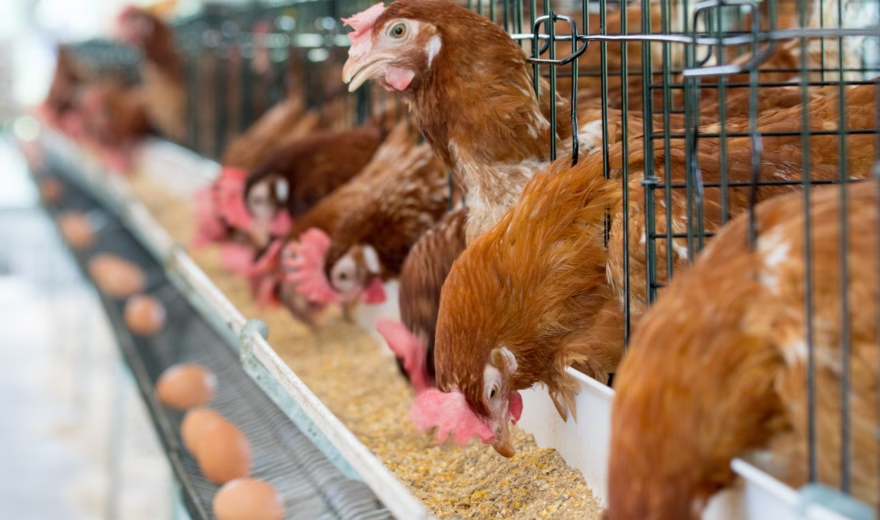
Laying hens are kept in a poultry house where eggs are produced and collected.
25 Aug 2026

Salmonella in eggs: recent outbreak highlights the importance of targeted testing

A Salmonella outbreak linked to eggs from a Belgian poultry farm has now made at least 300 people ill. The incident once again shows the importance of systematic monitoring and timely laboratory testing throughout the egg supply chain.

04 Feb 2026

The importance of trend analysis in the food industry: from data to strategic decisions

Huge amounts of data are collected daily in the food industry: analysis results, audit findings, complaints, KPIs and more. Yet this information often persists in silos without moving forward: trend analyses. It is precisely these analyses that make the difference between reactive firefighting and proactive management of quality and food safety.

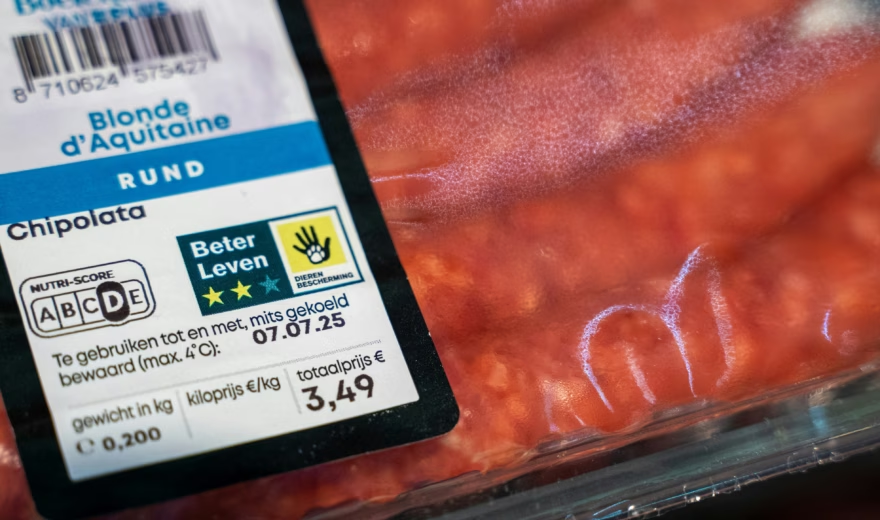
Close-up photo of packaged beef chipolata with product information and nutrition label.
23 Jun 2026

Errors in Label Verification: Where the Risk Lies

In the food industry, label verification is much more than a final administrative step in the quality process. It is a critical control measure within food safety and QA, with a direct impact on consumer safety, compliance, and the risk of recalls. Yet in practice, it turns out that label checking and verification remain a structural weak point within many organizations.

Sign up for our newsletter

Sign up

Naam

Related services

Incident Management

Food safety advice

Allergen analysis and allergen management

Microbiological research